Best Drone for Filmmaking: Picks That Fly Right for Cinematic Work
The number of options for a filmmaker to choose from for their drone in 2026 has increased greatly. However, the number of options has also become more confusing due to DJI's vast amount of products. With the increase in technological advancements at affordable prices, finding the correct drone can be overwhelming.
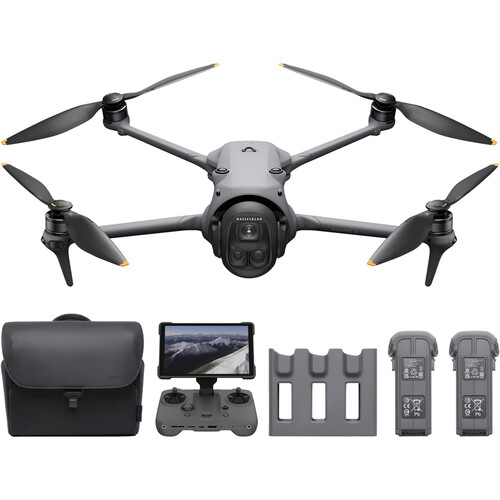
The DJI Mavic 4 Pro is considered by many to be the best drone for filmmakers at this point. Although the Mavic 4 Pro is the top pick for most filmmakers, it may not be the best fit for everyone, depending on the filmmaker's budget and type of work they are planning to create.
What Matters in a Filmmaking Drone
To make an educated decision when it comes to selecting a drone for filming, consider the following elements:
Camera Quality and Codec Support
When considering a drone for filmmaking purposes, resolution numbers don't provide the full picture. Instead of focusing solely on the resolution of the drone's camera, focus on the codec it supports, the color profiles it offers, and whether the drone provides a flat log profile for color grading. A drone that records 4K in H.264 and doesn't provide a log profile will provide footage that appears drastically different than the footage captured with your ground level camera.
To provide high-quality color grading, a drone must provide at least 10-bit color depth and a log profile. In addition to providing high-quality footage, the bitrate of the recorded footage is equally as important since highly compressed 4K footage can quickly deteriorate once you begin pushing it in applications such as DaVinci Resolve or Adobe Premiere.
Flight Time and Battery Strategy
Regardless of what the manufacturer states, listed flight times are always overly optimistic. Realistically, subtract approximately 20 percent from the listed flight time to account for real-world flight conditions including wind, maneuverability, and the fact that you should be landing the drone before the battery is completely depleted. For film-related projects, take into consideration the amount of time it takes to set up the drone, test flights, reposition the drone, and complete multiple takes. Having at least three batteries is virtually essential for any extended film shoot day.
Obstacle Avoidance and Safety
In most cases, a film drone is flying near people, equipment, and/or talent. As a result, using a standard consumer drone with limited obstacle detection capabilities presents a significant risk to safety. While basic forward-looking obstacle avoidance is better than nothing, ideally you're looking for omnidirectional obstacle avoidance at minimum. When you're preoccupied with framing a shot, you shouldn't have to simultaneously watch for potential obstacles approaching from behind, to the side, etc. One incident of a collision can ruin an entire shoot day and potentially cost significantly more money than the drone itself.
DJI Mavic 4 Pro: The Best Option for Most Film-Based Projects
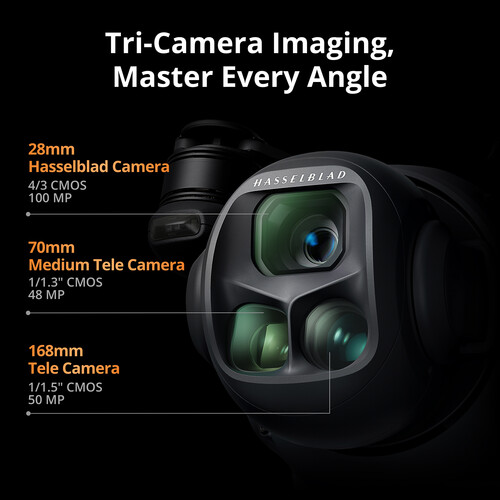
While the Mavic 4 Pro is an advancement over its predecessor, the Mavic 3 Pro, it's a relatively good compromise between portability and professional performance. B&H reviewers are calling it a "huge jump" over the Mavic 3 Pro for both photographic and videographic uses, with one seasoned pilot noting that the Mavic 4 Pro "easily surpasses" the Mavic 3 Pro in both areas. The key feature to the Mavic 4 Pro is the three-camera system featuring Hasselblad color science. However, the real difference for filmmakers lies in the details of the Mavic 4 Pro.
Camera System
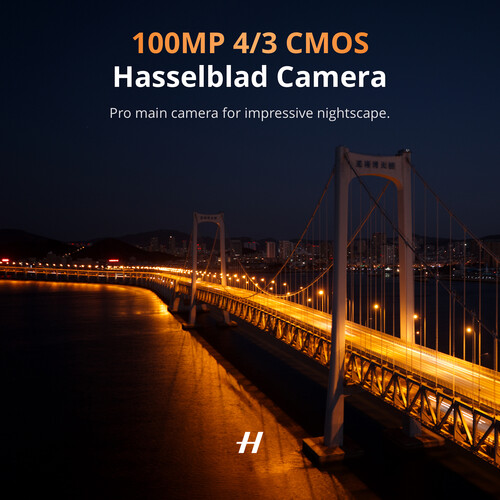
The Hasselblad wide angle lens captures images up to 6K at 60 frames per second in HDR, and 100 megapixel still images. The 4/3 type CMOS sensor, with the ability to adjust the aperture, allows you to somewhat control depth of field, and receive clear starburst effects on light sources. The Hasselblad medium telephoto (48MP, 70mm equivalent) and the Hasselblad standard telephoto (50MP, 168mm equivalent) capture images in 4K60 HDR. Additionally, you're able to capture slow-motion footage at 4K120 on the Hasselblad wide and medium telephoto lenses, which is extremely helpful for dramatic reveal shots, and nature footage.
For filmmakers, the important aspects of the Mavic 4 Pro include 10-bit D-Log profiles for consistency in color grading, dual-native ISO fusion for improved clarity in low-light environments, and 4:2:2 All-I encoding supported on the Creator Combo version. The 512 GB internal SSD included in the Creator Combo version is a major advantage for filmmakers because it enables higher-bitrate All-I recording allowing for greater flexibility during post-production.
Note that the Mavic 4 Pro does not support Apple ProRes recording. DJI has stated there are no current plans to implement ProRes recording in future versions of the Mavic 4 Pro, so if ProRes recording is a requirement for your workflow, you'll need to explore either the DJI Inspire 3 or plan to transcode in post.
Infinity Gimbal
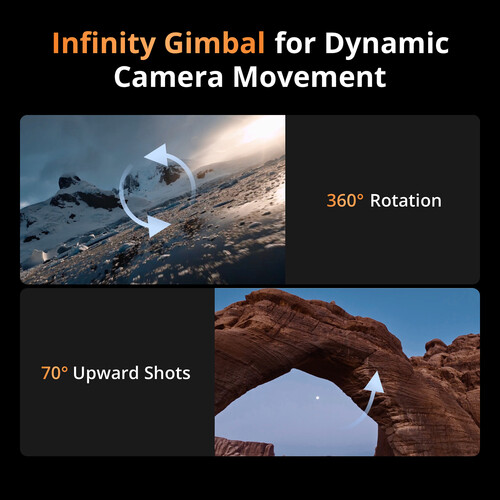
The old-style hang-down gimbal is gone. DJI has replaced it with a spherical ball-shaped 360-degree Infinity Gimbal that dramatically expands your creative options for aerial shots. You have 440 degrees of roll rotation, 160 degrees of pitch, and the ability to capture shots that go 70 degrees above.
The added ability to capture shots directly upwards opens up possibilities for shot ideas that would have otherwise required the use of more expensive cinema drones. You can now capture Dutch angles, tilt reveal shots looking up at structures/buildings/cliffs, tracking shots that orbit around a subject, all with a drone that fits inside a shoulder bag.
Flight Performance and Safety
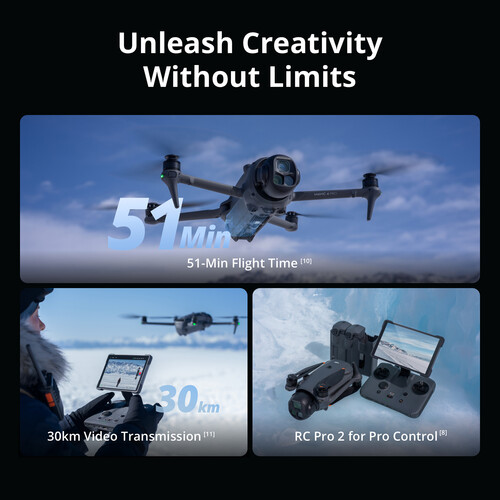
The Mavic 4 Pro has a maximum flight time of 51 minutes (approximately 40 minutes in real world conditions), and can reach speeds of up to 60mph. The Mavic 4 Pro features an omnidirectional obstacle avoidance system with six low-light fisheye sensors rated at 0.1 lux sensitivity, as well as forward-facing LiDAR. This means you can capture footage in twilight conditions and have confidence that the drone will avoid objects traveling at speeds up to 40mph. ActiveTrack 360 is the enhanced tracking mode that now allows the drone to make autonomous decisions regarding navigation, and can detect vehicles at distances of up to 656 feet, making it ideal for automotive cinematography.
O4+ Video Transmission can reach up to 18.6 miles with 10-bit HDR quality feedback displayed on the controller screen. The RC Pro 2 Controller (included with the Creator Combo) includes a 7-inch Mini-LED display at 2000 nits, which provides the ability to view the image you're framing with sufficient brightness in sunlight without having to shade the screen with your hand.
What B&H Reviewers Say
B&H reviewers seem to be pleased with the Mavic 4 Pro, although they've identified several quirks associated with the drone. One reviewer mentioned that while the Mavic 4 Pro is excellent, DJI's Wi-Fi based activation process can be frustrating to work through, and may require alternative methods to register the controller, such as a mobile hotspot. This is a problem that exists among all of DJI's products and is something to keep in mind prior to attempting to activate a new drone for the first time on a set. Always perform your initial setup at home, not on-site.
Another reviewer complimented the Mavic 4 Pro, and the RC Pro 2 controller combination for being an amazing flying and capturing experience. They also pointed out that no U.S.-based competitor currently equals DJI in terms of function.
Alternative Options for Film Work
While the Mavic 4 Pro isn't the best choice for every filmmaker, there are several options for film work that offer a viable alternative depending upon your budget, production size, and/or specific needs.
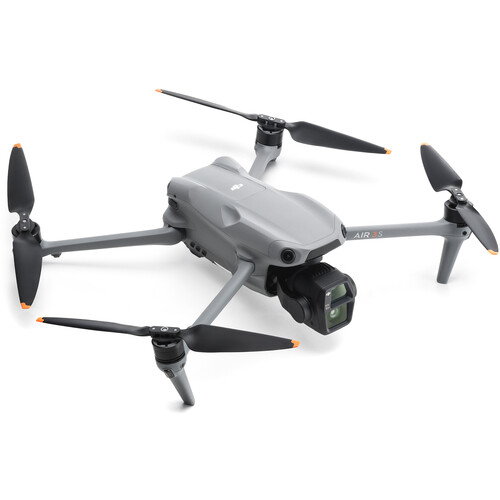
DJI Air 3S: A Budget-Friendly Option
For film work, the DJI Air 3S is the most affordable filmmaking drone today. The cost of the Air 3S is a fraction of the Mavic 4 Pro and yet, it can produce high-quality video with a dual-camera system and 4K capability. Although the Air 3S doesn't come close to matching the 6K resolution of the Mavic 4 Pro, nor its triple-camera versatility, or 360-degree gimbal, it is more than sufficient for producing B-Roll work and small-scale productions.
The Air 3S has the same obstacle detection capabilities as the Mavic 4 Pro, along with solid flight time and compatibility with the DJI ecosystem. The Air 3S is the perfect entry-level drone for those new to aerial filming. You can also find the lowest Air 3S price on Amazon by comparing prices at multiple online stores.
DJI Inspire 3: A Cinema Workhorse
For productions that require top-tier image quality and are willing to pay for it, the DJI Inspire 3 is the gold standard in cinema drones. It can capture 8K-resolution footage using a full-frame sensor, and it supports Apple ProRes RAW. Additionally, the Inspire 3 is designed to allow for two-person operation (pilot, and camera operator). While the Inspire 3 is priced in a completely separate range from the Mavic 4 Pro, and it's a much larger and heavier drone, if you're working on a feature film, a high-end commercial, or a broadcast show where the aerial footage has to be indistinguishable from footage captured on an ARRI or RED on the ground, the Inspire 3 is the only logical choice.
DJI Mini 5 Pro: Sub-249g for Easier Compliance
Although the Mini line falls below the 249-gram weight threshold in many countries, which can greatly reduce the compliance burden associated with drone operations, the Mini 5 Pro cannot compete with the Mavic 4 Pro regarding image quality. That said, for basic aerial shots, such as establishing shots, or for operations in locations where you simply want to minimize the amount of paperwork associated with your drone operation, the Mini 5 Pro has a legitimate place in a filmmaker's arsenal. Consider the Mini 5 Pro to be a secondary tool for use in conjunction with a more capable drone, rather than the primary tool for capturing your film's aerial footage.
FAA Regulations and What Filmmakers Need to Know
You can't seriously discuss drones for filmmaking without addressing the regulatory issues associated with drone operation, since failure to comply with the relevant regulations can result in fines, suspension of your ability to operate a drone, or even worse.
Part 107 Certification
In order to legally operate a drone commercially in the United States, which encompasses virtually any type of film or video production that generates income, you must obtain an FAA Part 107 Remote Pilot Certificate. The test covers subjects related to airspace, weather, loading and performance, and operational considerations.
The Part 107 exam is relatively easy if you prepare for it properly, however you must successfully complete the test and maintain your certification through periodic recurrent knowledge tests that are conducted every 24 months. Operating a drone commercially without first obtaining a Part 107 certificate is a federal offense, and in addition, production insurance will not protect you if something goes wrong.
Remote ID and Airspace
Beginning in September 2023, all drones manufactured after that date are required to include Remote ID functionality. This capability enables your drone to transmit its identity and location to the FAA while it is airborne, similar to how aircraft transponders function. Also, you should understand airspace restrictions, Laanc authorization for controlled airspace adjacent to airports, and any local ordinances that may pertain to your shoot location. From a filmmaker's perspective, this means performing the necessary airspace research prior to each shoot, and not simply assuming that you can fly your drone anywhere you wish.
The DJI Import Situation
As of the end of 2025, there is considerable regulatory uncertainty surrounding the importation of DJI products into the United States. As a result, B&H reviewers have noted concerns with respect to availability of these products, with one reviewer stating that although stock was available at various retailers, the future of the import process remained uncertain. If you are considering investing in a DJI product for your production work, it's worth continuing to monitor developments relative to this topic. For now, DJI drones remain available at B&H and many other large retailers.
Finding the Right Drone for Your Production Needs
Selecting the correct drone for filmmaking ultimately depends on a truthful evaluation of the nature of the work you are undertaking. Independent filmmakers and videographers generally prefer the Mavic 4 Pro in its Creator Combo configuration, as it strikes a suitable balance between image quality, portability, and the types of features they need. The 6K Hasselblad camera with 10-bit D-Log in the Mavic 4 Pro provides footage that grades as well as footage captured with high-end cinema cameras such as the Blackmagic Pocket 4K or Sony FX series.
The 360-degree gimbal and ActiveTrack 360 provide filmmakers with opportunities to create shots that previously would have required a much larger rig. Additionally, the 51 minutes of flight time provided by the Mavic 4 Pro minimizes the number of battery changes you will need to make during a typical shoot day.
For commercial and corporate work where the aerial component of the production is a significant factor, combining the Mavic 4 Pro with good lens selections on the ground and high-quality on-camera monitoring will give you a very capable production package without requiring a dedicated drone team.
For high-end productions that require extremely high levels of image quality and cannot afford to compromise, the Inspire 3 is the de facto industry standard. However, for all other professionals engaged in high-end production work, the Mavic 4 Pro is the better choice.
Frequently Asked Questions
What is the best drone for filmmaking in 2026?
The best all-around drone for filmmaking in 2026 is the DJI Mavic 4 Pro. It offers a triple-camera system featuring Hasselblad color science, 6K60 HDR video, a 360-degree Infinity Gimbal, and 51 minutes of flight time. B&H reviewers describe it as a huge leap forward from the Mavic 3 Pro. For high-end cinematic work, the DJI Inspire 3 is the industry standard, but it is significantly more expensive.
Do I need a license to fly a drone for filmmaking?
Yes. To operate a drone commercially in the U.S., regardless of whether you are paid for the production, you need an FAA Part 107 Remote Pilot Certificate. Obtaining the certificate involves taking a knowledge test covering airspace, weather, and operational considerations. Flying commercially without first obtaining a Part 107 certificate is a federal offense and will void your production insurance.
Does the DJI Mavic 4 Pro support Apple ProRes?
No. According to DJI, the Mavic 4 Pro does not support Apple ProRes and there are no plans to add it. The Creator Combo version of the Mavic 4 Pro does support 10-bit 4:2:2 All-I encoding at high data rates, providing a great deal of flexibility in terms of post-production capabilities. If ProRes is a strict requirement, you'll need to consider the DJI Inspire 3, or plan on transcoding your footage. The Mavic 4 Pro is also available at Amazon for comparison.
How long can a filmmaking drone actually fly?
Manufacturers measure flight time under optimal conditions. Based on manufacturer specs, the DJI Mavic 4 Pro reportedly flies for 51 minutes, however, you can reasonably expect to achieve 35 to 40 minutes of flight time per battery, accounting for wind, maneuverability, and reasonable safety margins for landing. Plan on having 3 to 4 batteries for a full day of filming. The DJI Air 3S has slightly less flight time, but is otherwise a very capable drone for smaller aerial shoots.
What is the difference between the DJI Air 3S and Mavic 4 Pro for filmmaking?
The Air 3S is a capable mid-range drone with two cameras and 4K video, whereas the Mavic 4 Pro has three cameras including a Hasselblad sensor that captures 6K60, the 360-degree Infinity Gimbal, LiDAR obstacle avoidance, and longer flight time. Additionally, the Mavic 4 Pro's Creator Combo version supports 10-bit 4:2:2 All-I encoding. For serious filmmaking work, the Mavic 4 Pro is clearly the better choice, but the Air 3S is a viable option for B-Roll and low-budget productions.
Should I wait for future DJI models or buy now?
If you need a drone for filmmaking now, the Mavic 4 Pro is an excellent choice and there is no rumored replacement model on the horizon. There is greater uncertainty surrounding the ongoing regulatory environment for importing DJI products into the U.S., and as a result, if drone-based production is a key element of your production strategy, purchasing a drone sooner rather than later may be the safest course of action.