
Blackmagic Pocket Cinema Camera 4K Review: Still Worth Buying?
The Blackmagic Pocket Cinema Camera 4K has been out since 2018 and is still one of the most talked-about cameras in the indie filmmaking world. That's a little crazy given how quickly camera technology advances, but the Blackmagic Pocket Cinema Camera 4K continues to sell well simply because no other camera at this price point offers Blackmagic RAW, 13 stops of dynamic range, and a free copy of DaVinci Resolve Studio. The raw image quality is far superior to what you would normally expect, and B&H reviewers continuously say that the color science of the camera is one of the biggest advantages of the camera. One reviewer stated, "It's dead simple to use + 4K + Resolve + low price = good deal," and that sums it up fairly well.
The Blackmagic Pocket Cinema Camera 4K is not a perfect camera. In fact, it has many flaws. Therefore, we will discuss the pros and cons of the Blackmagic Pocket Cinema Camera 4K, including what it delivers, what people commonly complain about, and if the Blackmagic Pocket Cinema Camera 4K is still worth purchasing in 2026.
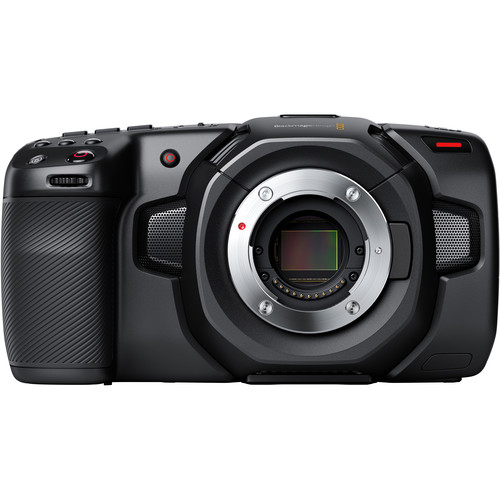
Sensor and Image Quality
The 4/3" sensor of the Blackmagic Pocket Cinema Camera 4K allows for capturing up to DCI 4K (4096 x 2160) at 60 frames-per-second, utilizing a dual native ISO of 400 and 3200. The dual native ISO is significant because it means that you can shoot in low light conditions and the image will remain intact. However, do not expect the image to be as bright as a full-frame Sony A7S III in extremely low light. Although the sensor can capture images up to ISO 25,600, you should avoid pushing the ISO beyond 3200 unless absolutely necessary.
With 13 stops of dynamic range, you will have a lot of flexibility in post-production to adjust the exposure of your shots. When capturing in Blackmagic RAW, you will have a tremendous amount of latitude to adjust the exposure and/or brightness of your shots in post-production. Many 8-bit mirrorless cameras cannot compete with the Blackmagic Pocket Cinema Camera 4K in terms of dynamic range. Additionally, the Blackmagic Pocket Cinema Camera 4K comes with ProRes RAW and ProRes 422 options, although Blackmagic RAW is the preferred option. ProRes RAW and ProRes 422 provide additional flexibility to your post-production process. Blackmagic RAW is capable of producing the highest quality images at the lowest file sizes. B&H reviewers continually compliment the image quality of the Blackmagic Pocket Cinema Camera 4K. A user who purchased his second Blackmagic Pocket Cinema Camera 4K commented that he was "still very happy with the look" after using the camera for several years, especially when using Sigma Art lenses. Another reviewer commented that the colors were "pretty amazing," which aligns with the opinions of many in the filmmaking community. Blackmagic's color science produces a cinematic look directly from the camera.
Codec Options and Recording
In terms of codec options, the Blackmagic Pocket Cinema Camera 4K has a staggering number of options, including Blackmagic RAW at multiple bitrates, Apple ProRes RAW, ProRes RAW HQ, and various ProRes 422 flavors. As mentioned earlier, at this price point, the number of codec options offered by the Blackmagic Pocket Cinema Camera 4K is absurd. With the recent 6.6 firmware update, the Blackmagic Pocket Cinema Camera 4K now includes a 2.8K raw mode at 80 frames-per-second for 4:3 anamorphic shooting and 75 frames-per-second in 4K raw at 2.4:1 widescreen. The slow-motion rates of the Blackmagic Pocket Cinema Camera 4K are up to 120 frames-per-second in cropped modes. These slow-motion rates offer a variety of options for slowing down the action in your shots.
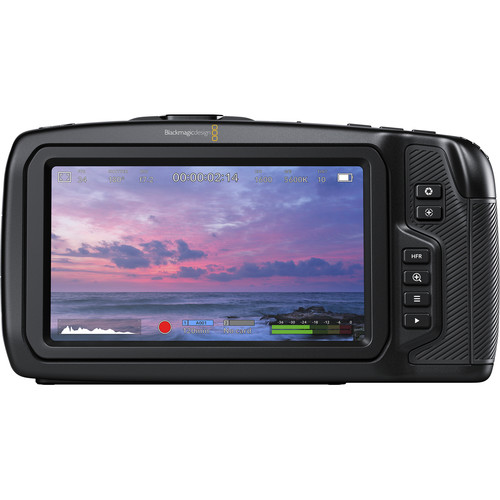
Internally, the Blackmagic Pocket Cinema Camera 4K records to either CFast 2.0 or SD/UHS-II card slots. This is a nice feature, but unfortunately, CFast cards are expensive and SD cards may not always be able to keep up with the higher bitrates of Blackmagic RAW. Most users ultimately record externally to an external SSD connected via the USB-C port. While this is a viable option, it is also an additional piece of equipment that you will need to purchase to complement your camera. There is a trade-off. While the Blackmagic Pocket Cinema Camera 4K offers a lot of flexibility in terms of recording, the most convenient method of recording requires adding additional gear to your camera rig.
DaVinci Resolve Studio License
Included with the Blackmagic Pocket Cinema Camera 4K is a license for DaVinci Resolve Studio. As B&H reviewers continually comment, this license alone is a significant value add. The combination of the camera and Resolve is a fantastic value, offering a professional-level video editor, Blackmagic RAW recording capabilities, advanced color grading tools, and a multitude of third-party accessories that can be integrated into the system. The seamless integration of these components is a significant advantage of the Blackmagic Pocket Cinema Camera 4K.
Lens Compatibility
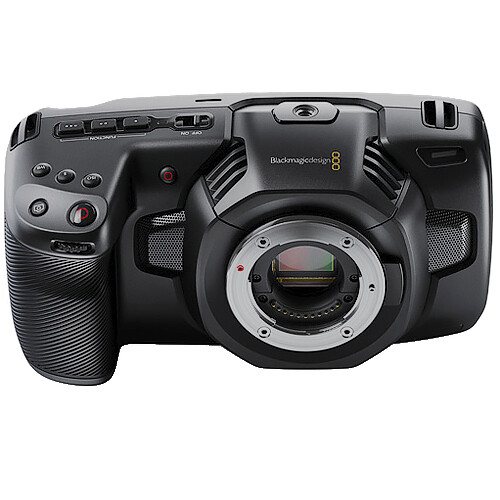
The active Micro Four Thirds (MFT) mount on the Blackmagic Pocket Cinema Camera 4K is both a strength and a weakness. On the plus side, MFT lenses are typically smaller and lighter than their full-frame counterparts. Additionally, the MFT mount is electrically controlled allowing for autofocus and aperture control with compatible lenses. Finally, you can also attach PL, C-mount, and EF lenses to the Blackmagic Pocket Cinema Camera 4K with separate adapters, opening up a vast array of lens options.
On the negative side, the 2x crop factor inherent in the MFT mount is a drawback. A 25mm MFT lens will produce the equivalent field of view as a 50mm lens on full-frame. This can limit your ability to obtain wide-angle shots and you will likely need to utilize a Metabones Speed Booster to regain some of the lost width and improve your low-light performance slightly. Users who have utilized the Sigma 18-35mm f/1.8 lens with a Speed Booster report excellent results, effectively obtaining a wider field of view while improving their low-light performance.
Built-In Image Stabilization
Unfortunately, the Blackmagic Pocket Cinema Camera 4K lacks built-in image stabilization. Therefore, you will need to rely on either lens-based image stabilization or external image stabilization solutions. While the Blackmagic Pocket Cinema Camera 4K may not be ideal for run-and-gun style filming, it can be used successfully for stabilized shots, provided you build a sufficient rig.
Battery Life and Ergonomics
Now let's talk about the elephant in the room regarding the Blackmagic Pocket Cinema Camera 4K, battery life. The camera runs on Canon LP-E6 type batteries and drains rapidly. In fact, you're looking at approximately 45 minutes to an hour of continuous recording, depending on your codec and frame-rate settings. This is not acceptable and is arguably the largest complaint about the camera from virtually every forum and review website. Fortunately, the separately available Pocket Battery Grip improves the situation, but it adds to the growing list of accessories you'll need to purchase to complete your camera rig.
The body of the Blackmagic Pocket Cinema Camera 4K is made of carbon fiber composite material making it both lightweight and durable. B&H reviewers have commented positively on the light weight of the camera stating that it is "easy to use" and "lightweight." Unfortunately, the light weight of the camera creates an issue when attempting to stabilize the camera. The camera is compact, but not designed to resemble a traditional camcorder, therefore, handheld shooting without a cage or rig is cumbersome for extended periods of time.
As previously mentioned, most Blackmagic Pocket Cinema Camera 4K users create a rig consisting of a cage, a handle, an external battery solution, and possibly an external monitor. The 5-inch display of the Blackmagic Pocket Cinema Camera 4K is a built-in 5-inch touchscreen display, which is the same display interface found on the URSA Mini, and is capable of displaying 3D LUT information. However, by the time you've created a rig sufficient enough to allow for comfortable handheld shooting, you've potentially doubled or tripled the original price of the camera.
Audio and Connectivity
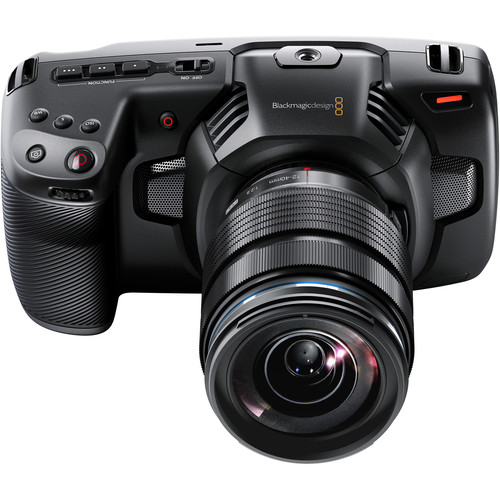
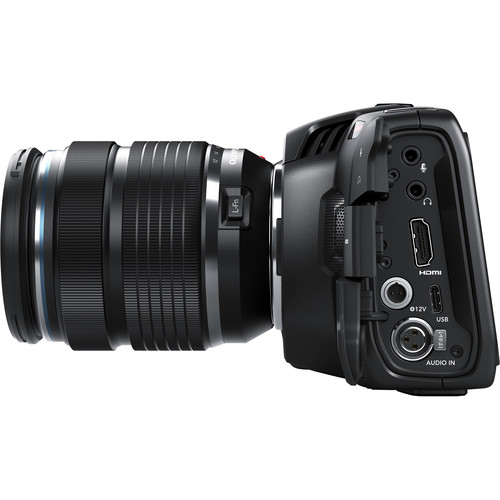
Audio capabilities on the Blackmagic Pocket Cinema Camera 4K are surprisingly robust. You receive a mini-XLR input with 48V phantom power, a 3.5mm stereo jack, and a built-in stereo microphone. The mini-XLR input is a welcome addition for users wanting to connect professional microphones. However, you will require an adapter to connect standard XLR microphones to the camera. The internal stereo microphone is adequate for scratch audio and reference tracks, but you will want to utilize external audio for any serious applications.
You also receive a full-size HDMI output to send a clean signal to an external recorder or monitor, as well as Bluetooth remote control capability for those occasions when you wish to trigger recording remotely. Finally, the USB-C port serves two functions: providing access to external recording and firmware updates. The connectivity options provided on the Blackmagic Pocket Cinema Camera 4K are comprehensive and suitable for a camera of this size. The lack of an SDI output indicates that this camera is intended for independent and small-scale production purposes, and is not suited for use in broadcast applications.
Who Should Purchase the Blackmagic Pocket Cinema Camera 4K in 2026
The Blackmagic Pocket Cinema Camera 4K is ideal for filmmakers prioritizing image quality and post-production flexibility over convenience. If you are transitioning from a DSLR or mirrorless camera and desire a true cinematic look without breaking the bank, the Blackmagic Pocket Cinema Camera 4K remains a competitive option. B&H reviewers who are film students, first-time cinema camera owners, and professional filmmakers alike agree that the image quality and included software of the Blackmagic Pocket Cinema Camera 4K make it difficult to pass up at this price point.
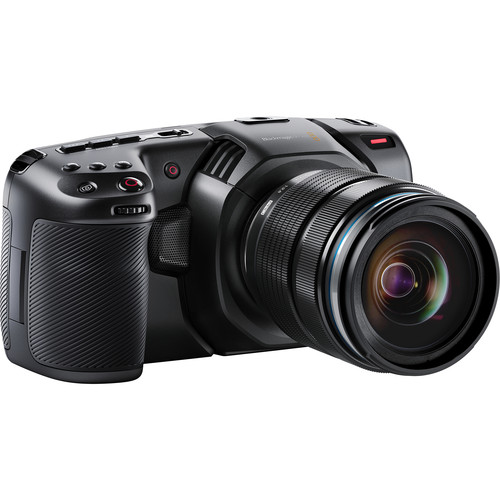
However, if you need fast and reliable autofocus, extended battery life, or a camera that can be easily carried without creating a rig, then the Blackmagic Pocket Cinema Camera 4K is not the best option for you. The Blackmagic Pocket Cinema Camera 6K offers a larger Super 35 sensor with an EF lens mount, resulting in reduced crop factor, increased resolution, and a greater variety of lenses available for native EF mounts. The Blackmagic Pocket Cinema Camera 4K is designed for use as a hybrid photo/video tool and is ideal for photographers seeking to expand their creative possibilities.
The Blackmagic Pocket Cinema Camera 4K is available on Amazon, allowing you to compare pricing among vendors. Please also consider that you will need to budget for accessories. A sturdy camera cage and sufficient batteries are essential to creating a functional rig for the Blackmagic Pocket Cinema Camera 4K. The Blackmagic community offers numerous tutorials and how-to guides to help you create a suitable rig and learn how to operate your camera.
Frequently Asked Questions
Is the Blackmagic Pocket Cinema Camera 4K good for beginners?
Yes, and B&H reviewers confirm this. Several users have described it as their first cinema camera and praised the ease of operation. The touch-screen interface of the Blackmagic Pocket Cinema Camera 4K is easy to understand, the DaVinci Resolve Studio license is included and allows you to begin editing immediately, and the Blackmagic community provides a wealth of knowledge and resources for new users to learn how to properly use their camera.
How long does the battery last on the Blackmagic Pocket Cinema Camera 4K?
Approximately 45 minutes to an hour of continuous recording with the included Canon LP-E6 type battery. The limited battery life is the largest criticism of the Blackmagic Pocket Cinema Camera 4K. Most users carry 4-6 spare batteries or invest in a Pocket Battery Grip or an external V-mount battery solution. Be sure to budget for additional LP-E6 batteries when you purchase your camera.
What types of lenses are compatible with the Blackmagic Pocket Cinema Camera 4K?
Any Micro Four Thirds (MFT) lens will fit natively. You can also use EF, PL, and C-mount lenses with adapters. Some popular options include the Sigma 18-35mm f/1.8 with a Speed Booster, Panasonic Lumix MFT prime lenses, and vintage cinema glass via PL adapters. Check B&H for MFT cinema lenses to see all the options available.
Will the Blackmagic Pocket Cinema Camera 4K autofocus?
The Blackmagic Pocket Cinema Camera 4K will autofocus with compatible MFT lenses, but it is a contrast-detect autofocus system and is not reliable enough for critical applications. The majority of filmmakers using the Blackmagic Pocket Cinema Camera 4K manually pull focus, as is typical in cinema production. If you require fast, reliable autofocus for run-and-gun filming, the Blackmagic Pocket Cinema Camera 4K is not the correct camera for you.
What type of memory cards does the Blackmagic Pocket Cinema Camera 4K use?
The Blackmagic Pocket Cinema Camera 4K has CFast 2.0 and SD/UHS-II card slots built-in. CFast cards can handle all codecs and bitrates, but they are expensive. SD cards will work for ProRes and lower bitrates of Blackmagic RAW, but may have difficulty keeping pace with the higher bitrates of Blackmagic RAW. Many users prefer to record to an external SSD connected via the USB-C port, which is less expensive per GB and offers more capacity for longer shoots.
How does the Blackmagic Pocket Cinema Camera 4K compare to the Blackmagic Pocket Cinema Camera 6K?
The Blackmagic Pocket Cinema Camera 6K has a larger Super 35 sensor with less crop factor, an EF lens mount for native Canon glass, and higher resolution recording. The Blackmagic Pocket Cinema Camera 4K is smaller, lighter, utilizes less expensive MFT lenses natively, and is priced lower. Both cameras have identical Blackmagic color science, codec options, and DaVinci Resolve Studio license. The Blackmagic Pocket Cinema Camera 6K is the better choice if you already own EF glass or need a wider field of view without adapters.