
Best Lights for Filmmaking: LED Panels, Tubes, and COBs Compared
Picking the best lights for filmmaking used to be pretty straightforward. You bought some tungsten fresnels, maybe a couple of Kino Flos, and called it a day. But the LED market has exploded into so many different form factors that choosing the right lights for your kit actually takes some thought now.
COBs, panels, tubes, flex mats, wands, pixel bars, and each does something different. Aputure's LS 600d is designed to address different issues than a tube light, and will not provide the same impact as a focused COB. Therefore, to avoid buying a bunch of lights that will end up collecting dust, it is essential to know what each form-factor is going to bring to the set before you invest a bunch of money in them.
The Three Main LED Form-Factors
COB Lights (Chip-on-Board)
COBs are point-source lights. This means the light is generated by a single concentrated LED chip. This allows you to have a directable light that you can shape with various modifiers such as fresnels, softboxes, barn doors etc. These are basically the modern replacements for traditional tungsten and HMI fixtures.
Most professional COBs utilize a Bowens S-mount, allowing you to take advantage of a huge collection of light-shaping devices. Your COB is essentially your primary light, your backlight after diffusing it, your bounce light. A COB is the backbone of any serious lighting package.
LED Panels
LED Panels utilize multiple LEDs mounted across a flat surface, producing a soft, even light source. Because of this natural softness, you typically don't need any additional modifiers when using a panel as a fill or flat beauty light.
They are commonly used for interviews, corporate shoots and any other time you would like to have soft wrap around your subject without having to set-up a softbox onto a COB. Unfortunately, panels cannot be focused into a hard beam and generally have lower punch per watt compared to a COB utilizing a modifier to produce the light.
Tube Lights
Tube Lights are long, cylindrical LED lights. Tubes are used as both visible practical lights (in the frame), and/or as hidden edge/accent lights just outside of the frame. Tube lights have become popular for music video shoots, narrative shoots and any shoot where you need streaks of color or motivated lighting. Most tube lights currently being sold feature full RGB color control and pixel mapping, enabling you to create color chase effects, etc. Tubes will never generate near the amount of light that a COB or Panel will generate. However, that is not what tubes are intended to do.
COB Lights: The Set Workhorse
When constructing a new lighting package from scratch, a COB light should be your first acquisition. COBs are the most versatile individual fixture you can buy. With the correct modifier, a COB light can be made into virtually any light you might require. A hard-key light using a Fresnel, a soft-fill light using a dome, a slash light on the background using Barn Doors.
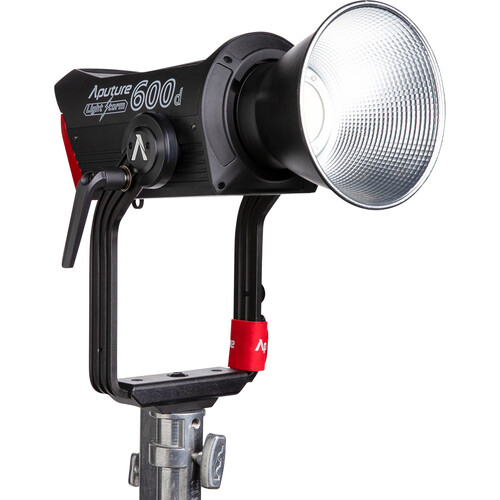
The Aputure LS 600d is one of the highest powered COB lights on the market today and one of the reasons why it is so highly regarded is due to its ability to deliver 600 watts of light from a single daylight-balanced LED chip at 5600K. The LS 600d produces 98,500 Lux at approximately 3' away with the Hyper Reflector, which is roughly equivalent to the output of a 1200W HMI light using less than half the amount of power.
Both CRI and TLCI ratings of 96 indicate a very high degree of accuracy in capturing skin tones and colors. B&H reviewers have praised the overall build quality of the LS 600d stating that it is "superior in every way" to the smaller 300d and that a single unit can effectively illuminate a room when utilized with a 6x6 diffusion frame.
The LS 600d features a Bowens S-mount, making it compatible with practically every softbox, fresnel and beauty dish on the market. It runs on AC power worldwide (100-240V) and has dual V-mount battery plates on the control unit for location work, though battery life is limited at full output.
Control options include an onboard OLED display, 2.4GHz remote, the Sidus Link Bluetooth app and 5-pin DMX512 for integration into larger lighting setups. It also includes eight built-in lighting effects like lightning, TV flicker and paparazzi flash.
You may notice variations in pricing for the LS 600d when searching on Amazon as well. If you plan on purchasing the LS 600d, it is recommended that you shop around and compare prices. While it is certainly not inexpensive, the output-to-price ratio is one of the best available for a light of this caliber.
Budget COB Option: Godox SL60IIBI
While many of us require 600 watts of light, many smaller productions will not. The Godox SL60IIBI provides a bi-colored COB with a lower cost and only draws 75 watts of power. In addition to providing lower power consumption, the Godox SL60IIBI produces 25,100 Lux at 3' with its reflector.
The bi-color SL60IIBI ranges in color temperature from 2800K to 6500K, making it possible to match either tungsten or daylight without switching out lights. The CRI rating is 96 and the TLCI rating is 97. The SL60IIBI is capable of producing light that is actually more accurately colored than some of the higher priced lights available today.
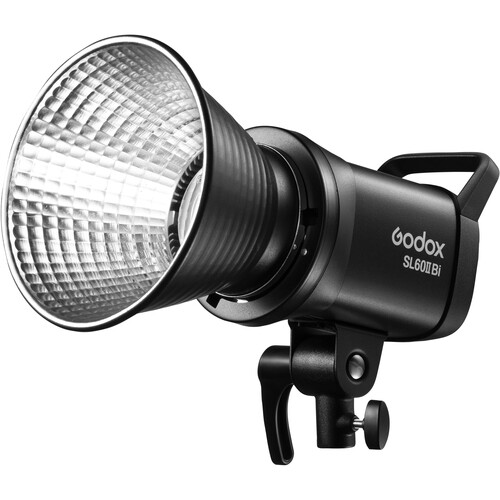
At only 3.3 lbs, it is light enough to place on a C-stand without concern for tipping. The SL60IIBI utilizes the same Bowens S-mount as the Aputure and B&H users have referred to it as "awesome" and "perfect" for studio applications.
The primary limitation is that the SL60IIBI is limited to AC-only power, which means you will not be able to use it in the field with battery power. For anyone considering their first COB or a second fill light, the value of the SL60IIBI is difficult to beat. You can also find it on Amazon for price comparisons.
LED Panels: Soft Light Without the Rigging
LED Panels fill a unique void that COBs cannot fill easily without modifying the light. When you require broad, even illumination for an interview setup or a flat fill across a talent's face, an LED Panel simply works without needing to add any additional equipment. You simply turn it on and point it.
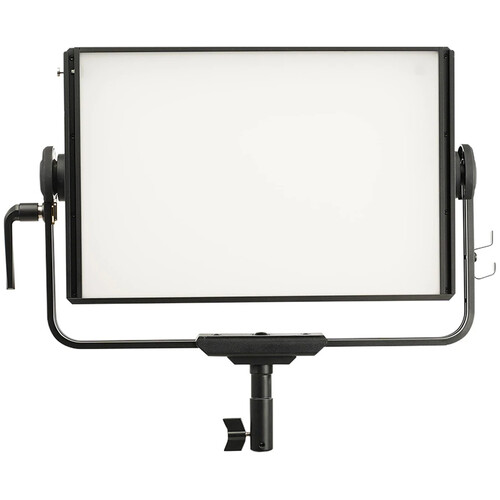
Aputure's Nova P300c is Aputure's top-of-the-line LED Panel, and it is genuinely impressive in terms of color control. The Nova P300c has full RGB capabilities with a color temperature range from 2000K to 10,000K and a library of 300 industry standard gel presets. As opposed to physically clipping gels to your barn doors, you can program the Nova P300c to mimic a particular Rosco or Lee gel.
The CRI rating is 95 and the TLCI rating is 95. The SSI rating is 85 at 3200K. The Nova P300c delivers 9000 Lux at 3' with its daylight setting and has a wide 120 degree beam angle that allows you to cover a large area.
B&H reviewers who upgraded from older Aputure LS 1x1 panels report a significant jump in both power and color accuracy. One reviewer mentions running two P300c panels off an EcoFlow power station for nearly six hours at 50% output, which is a practical setup for location work. The main criticism is weight. At nearly 23 pounds, the P300c isn't something you casually throw in a bag. If portability matters to you, factor that into your decision.
The P300c controls DMX and Bluetooth via the Sidus Link system, the same as the Aputure Light Storm COB fixtures. The P300c also accepts 24-48V DC battery input for operation in the field, although with a power draw of 360W, you will need a substantial power station for operation.
Tube Lights: Practicals and Creative Accents
Tube lights have carved out a role that other form factors can't really touch. You can tape them behind furniture as motivated practicals, line them up behind a window for a neon accent, or use them as subtle edge lights hidden just out of frame. They're the creative spice in a lighting kit rather than the main course.
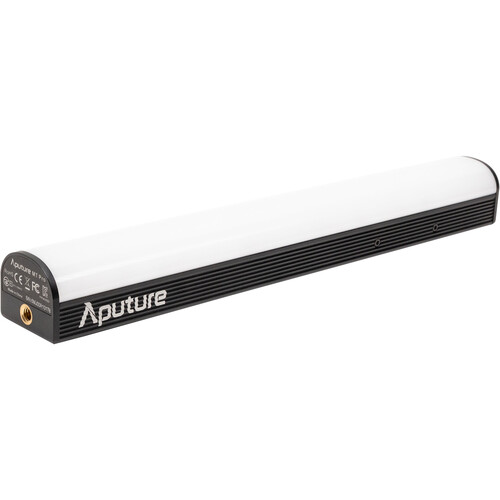
Aputure's MT Pro packs a surprising amount of technology into a 1-foot tube that weighs under a pound. It features 36 individually addressable RGBWW pixels, a color temperature range from 2000K to 10,000K, and color accuracy ratings of CRI 95 and TLCI 98.
That TLCI score is actually higher than both the LS 600d and the P300c, which makes sense since tube lights often end up visible in frame where color accuracy matters most.
The MT Pro runs entirely on its built-in rechargeable battery, providing about 2 hours at full brightness with USB-C charging. No cables to deal with, which is a big deal when you're taping these to set pieces.
It supports LumenRadio CRMX wireless control for professional DMX workflows and the Sidus Link app for Bluetooth adjustments. B&H reviewers use them mostly as hair lights and background accents, with one noting it has "good punch for the price" and another saying they liked it enough to buy a second one immediately.
If you need longer tubes with greater output, the Nanlite PavoTube series may be worth exploring. You can see the options in both 2-foot and 4-foot tube lengths available at B&H. The MT Pro is also available on Amazon if you wish to compare prices.
Building a Versatile Lighting Kit
The smartest approach to building a lighting kit is thinking about form factors rather than brands. You want at least one of each type because they solve fundamentally different problems on set. A COB with a modifier handles your key and back lights. A panel gives you quick, soft fill without extra gear. And a tube or two adds creative flexibility for color accents and practicals.
For a solid starting kit, pair something like the Godox SL60IIBI as your main COB with a mid-range panel for fill. Add an MT Pro tube for accent work and you've covered most situations a smaller production will encounter. As your budget grows, stepping up to the LS 600d gives you significantly more output for larger sets and daylight exterior work. If you want more ideas on affordable setups, check out our guide to film lighting kits that covers entry-level options in more detail.
Quick Comparison
| Light | Form Factor | Wattage | CRI / TLCI | Output (at 3 ft) | Color Temp | Weight | Power |
|---|---|---|---|---|---|---|---|
| Aputure LS 600d | COB | 600W | 96 / 96 | 98,500 lux (w/ reflector) | 5600K | ~14 lbs | AC + V-mount |
| Godox SL60IIBI | COB | 75W | 96 / 97 | 25,100 lux (w/ reflector) | 2800-6500K | 3.3 lbs | AC only |
| Aputure Nova P300c | Panel | 360W | 95 / 95 | 9,000 lux | 2000-10,000K (RGB) | ~23 lbs | AC + DC battery |
| Aputure MT Pro | Tube | ~7W | 95 / 98 | 159 lux | 2000-10,000K (RGBWW) | <1 lb | Built-in battery |
Specs That Actually Matter
When evaluating different light forms, pay attention to the following specifications:
- CRI and TLCI measure color accuracy. Anything above 95 is sufficient for professional work. TLCI is particularly relevant to filmmakers as it evaluates color reproduction specifically for video.
- Output (in lux) tells you how much light hits a surface at a given distance. Always compare at the same distance, and remember a COB's output with a reflector is significantly higher than its bare-bulb number.
- Color temperature range determines how easily you can match tungsten or daylight conditions. Bi-color capability saves time on mixed-lighting locations.
- Mounting system dictates what modifiers you can use. Bowens S-mount is the industry standard for COBs, providing the widest accessory selection.
- Power draw vs output affects how long you can run a light on batteries. Lower power consumption at a given output level means longer runtime on location.
For a deeper look at how Aputure's lineup compares across these specs, check out our breakdown of the Aputure Light Storm series. And if you need a monitor to evaluate your lighting on set, our guide to the best on-camera monitors covers what to look for.
Frequently Asked Questions
What is CRI and why is it important for filmmaking lights?
CRI (Color Rendering Index) measures how accurately a light source reproduces colors compared to natural light. Scores of 95 or above mean skin tones and colored objects will look natural on camera. TLCI (Television Lighting Consistency Index) is similar but designed specifically for video and is often considered more relevant for filmmakers.
Most professional LEDs from Aputure and Godox hit CRI 95+ these days, so this is primarily a concern with budget fixtures. You can browse high-CRI filmmaking lights at B&H to compare specs.
Can I use a COB light without a modifier?
You can, but in most cases you won't want to. A bare COB produces hard, directional light with strong shadows, which works for certain looks but is unflattering for most interview and narrative setups. The whole point of a COB with a Bowens mount is the modifier ecosystem. A softbox turns it into a soft source, a fresnel focuses it into a punchy spot, and barn doors let you shape the beam. Even the included reflector on most COBs makes a significant difference in output and beam control.
Will tube lights provide sufficient output for key lighting?
Generally no. A 1-foot tube like the Aputure MT Pro delivers 159 Lux at 3 feet, which works for accents and practicals but is nowhere near enough to key a subject unless you're shooting in very dark conditions at a high ISO. Longer 4-foot tubes get brighter but remain best suited as fill, edge, or background lights. If you need a key light, stick with a COB or a powerful panel.
Do I need RGB capabilities in my filmmaking lights?
It depends on your work. For corporate interviews, documentary, and event work, bi-color (tungsten to daylight) is all you need. RGB becomes valuable for music videos, narrative filmmaking, and product shots where you want colored lighting without physical gels. The digital convenience is genuinely nice but adds cost. Start with bi-color if you're on a budget.
What is the difference between V-Mount and Gold Mount batteries?
V-mount and Gold Mount are two competing battery plate standards for professional video equipment. They're physically different connections and not interchangeable. Most LED lights that accept external batteries use V-mount plates, which has become the more common standard. When buying lights with battery options, make sure the plate type matches whatever batteries you already own for your camera setup.
How many lights do I actually need?
For basic interview work, two lights (a key and a fill or backlight) will get you pretty far. For narrative work, three lights is the classic setup, and adding tubes for accents brings you to four or five. One powerful COB with good modifiers can handle a surprising amount of work on its own though. Start with one quality light rather than buying three cheap ones.