Speed Boosters for Video: Viltrox, Metabones, and Kipon Compared

When you shoot video on your Canon M50, I'm sure you have run into the exact same barrier that every other user has. While there are a few options in the native EF-M line-up of lenses available, the fact that the camera has a 1.6x crop factor makes shooting wide angles difficult.

This review will take a look at the performance of the most popular solution, the Viltrox EF-EOS M2 speed booster, which attaches to your Canon M50. We'll also go over what features make the Viltrox different than a Metabones Speed Booster Ultra and what type of performance to expect from both products.

While speed boosters work like "magic glass" for the image produced by your Canon EOS M50 and any lens you attach, the main differences among them are edge sharpness, build tolerances and autofocus reliability. A closer examination of these areas can be found through an analysis of user comments on all three products.

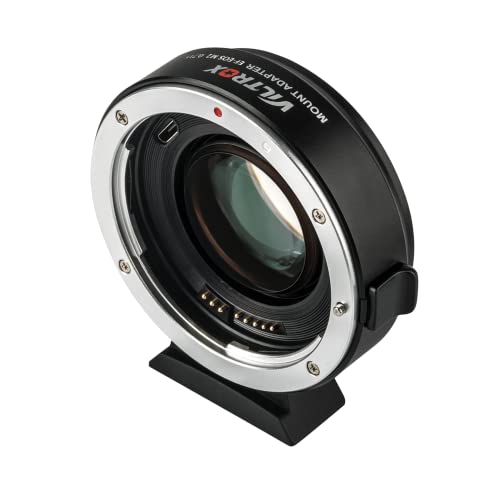
Viltrox EF-EOS M2 speed booster front view with mount adapter labeling

What a Speed Booster Actually Does

Speed boosters are focal reducers. They include optics that compress the entire image circle from a full frame lens onto the much smaller area of a crop sensor. As such they provide a wider angle of view as well as approximately 1 additional stop of light compared to using an EF lens directly on a camera without this type of adapter.

For example, take a 50 mm lens on a speed booster with 0.71 magnification. You would multiply the focal length of your lens (50 mm) by 0.71 to get 35.5 mm, then apply the 1.6x crop factor. The actual field of view of a 50 mm f/1.8 lens on an M50 ends up almost identical to what you would expect from a 57 mm lens, while gathering light like an f/1.2.

This is why many film makers use speed boosters. Their EF glass suddenly works the way it was designed to, more or less.

Speed Booster vs Plain Adapter

An adapter simply transmits electrical contact between the camera and lens while allowing the lens to remain in its original configuration. Therefore, both the focal length and aperture of the lens are preserved, but they are limited by the sensor size.

In contrast, a speed booster includes additional glass components through which all light passes before reaching the sensor. These additional components allow for greater light gathering capability (as described above), but also introduce their own optical characteristics that may degrade sharpness, cause aberration and produce flaring in various forms. Therefore, the cost of the speed booster is largely determined by how large those problems are likely to be.

The Viltrox EF-EOS M2 on the Canon M50

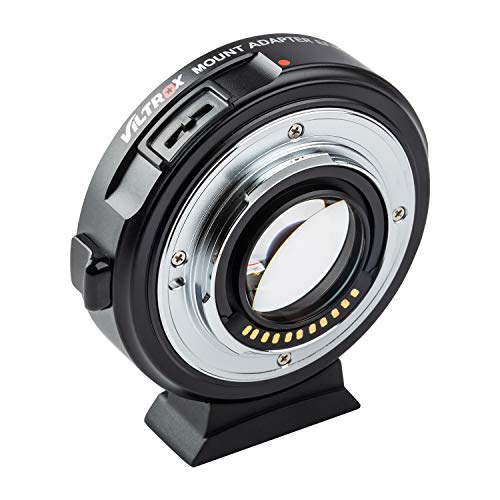
The Viltrox EF-EOS M2 has 4 optical elements divided into 4 groups. It uses gold-plated contact points to enable communication between the lens and the camera. A removable tripod foot with a 1/4 inch thread and a single USB connection to allow for firmware updates are present as well.

AF, IS and aperture control via the camera body are all supported by this adapter. That's quite an array of features for a lens adapter at this price point.

One thing that comes up constantly in reviews is to update your M50 firmware before attaching this item. Apparently several customers reported problems with the function of this product on older firmware versions. After updating the firmware, everything worked fine.

Viltrox is using the USB port to update the adapter firmware, to solve compatibility issues with certain lenses. Therefore, check out their website once you bought this product.

Viltrox EF-EOS M2 speed booster rear view with body and lens caps

Autofocus and Image Quality in the Real World

Mostly positive autofocus experiences were documented in M50-specific reviews. Users report that the focus speed on the M50 is almost as fast as native lenses in good lighting conditions. Additionally, several users report that it behaves better than older EOS M cameras.

In low-light situations, it still hunts a little bit more, which aligns with how the M50 itself performs during autofocusing. The face-tracking continues to function across adapters, which could be important if you do most of your shooting alone.

Reviews regarding image-quality are much more mixed. Most agree that the center area remains very sharp even wide-open. Unfortunately, many agree that the edges remain blurry as well. Users claim that the blur increases when either wider or larger-aperture lenses are used, and some reviewers call edge performance "a deal-breaker" when doing landscape-style shots.

On the other hand, numerous users state they cannot tell the difference between video interview footage taken with this combination versus footage taken using significantly costlier systems.

The Loose Screw Problem

A recurring issue should get its own section. Many users have experienced issues with loosening mounting screws on their Viltrox adapters. Loosened screws result in a wiggling lens, which can lead to unpredictable softness.

To help mitigate this issue, Viltrox includes both a hex wrench and a screw driver with every new purchase. Users that regularly tighten these screws report having no additional issues. If you take a couple minutes every so often to tighten these screws, you'll avoid ruining a shoot due to poor sharpness caused by a loosely mounted lens.

Reports of increased flares when shooting toward bright objects are also out there. However, not all users see them. So if you shoot lots of back-lit scenes, you might want to know about this potential issue.

Metabones Speed Booster Ultra: What the Extra Money Buys

The Metabones EF-M version runs five elements in four different groups, adds a positive lock to the lens and includes an arca-style mounting bracket. This version does not appear to be available on Amazon. However, it's available at B&H.

For those interested in comparing these adapters using side by side comparisons, the Sony E-mount version of the Metabones Speed Booster Ultra is the one most comparison tests use. The overall optical design remains the same across all mounts.

Metabones EF to E-mount Speed Booster Ultra adapter

Reviews that show side-by-side results keep arriving at the same general conclusions. The two adapters perform almost identically near the center of the image, with the Metabones being slightly sharper than the Viltrox. At the outer edges of the image, however, the Viltrox experiences significant amounts of blur and chromatic aberration while the Metabones continues to hold its composure.

A long-time user of the Viltrox states that they have tested their Viltrox extensively and conclude that it is approximately 99% as good as the Metabones. They would refuse to pay three times as much for the remaining 1%.

Who Should Pay Up

So, we can fairly say that if your primary area of operation falls within shallow depth-of-field (talking-head style interviews, weddings etc.) or high-motion video (run-and-gun style documentary, etc.), edge softness will be lost in bokeh. In that case, spending extra money on either lighting or audio may be a better investment than purchasing a Metabones.

On the other hand, you may require a flatter, deeper focus composition (where corner detail is important), or you may plan to rent your equipment often and cannot afford to constantly check screws for looseness. In those cases, the higher cost of the Metabones for build-quality and superior edge performance justifies the additional expense.

Another reviewer mentioned that there is another aspect to owning both versions of this adapter. Specifically, they stated that the "locking" feature on the mount is an underappreciated difference. They explained that heavy zoom lenses will fit tighter onto a Metabones due to less movement between the lens and camera body.

Speed Boosters for Sony E, Micro Four Thirds, and Fuji X

The Canon M50 isn't the only camera body that gets speed boosts. For Sony E mount, Viltrox makes the EF-E II, which covers APS-C sensors and works on bodies like the Sony A6400, or on full frame Alphas when those have been switched to Super 35 mode.

Many reviewers say the phase detect autofocus works, and the focus acquisition time is improved because you've got an additional stop of light. The third party lens compatibility can be spotty, though.

Viltrox EF-E II speed booster for Sony E-mount cameras

Micro Four Thirds and the Pocket Cinema Crowd

There's also a second option available for Micro Four Thirds cameras. That is the Viltrox EF-M2 II. This model is a more affordable option and has become very popular among owners of the Blackmagic Pocket Cinema Camera 4K who would like to use their EF zoom lenses again but would like to do so at a wider angle.

As the sensor on that camera carries roughly a two-times crop, this focal reducer becomes almost a necessity. One reviewer mentioned that some "touch-to-focus" functions won't work properly on the Pocket 4K through the Viltrox. Thus, consider using this product as a manual focus tool on that body. There is also a Metabones model designed specifically for this configuration, available at B&H.

Viltrox EF-M2 II speed booster for Micro Four Thirds cameras

Where Kipon Fits

Most of Kipon's focal reducers are manual. However, Kipon does make focal reducers for combinations that no other company currently offers.

These include Nikon F glass on Fuji X cameras, medium format lenses on mirrorless bodies, and PL-mount cine lenses on newer digital cameras. The optical components used in these products were provided by Kipon's partner IB/E Optics located in Germany. Reviewers generally praise Kipon's focal reducers for producing images of high clarity with good durability.

Kipon Baveyes focal reducer for Nikon F lenses on Fuji X cameras

Unfortunately, many of Kipon's focal reducers will eliminate your ability to use autofocus and electronic aperture control. Therefore, Kipon's focal reducers may be best suited for shooting cine lenses and old school glass and less suitable for modern EF zooms. However, if you're a manual shooter then losing autofocus and electronic aperture control may be acceptable to you. Otherwise, stick with either the Viltrox or Metabones speed booster products.

Which Speed Booster Should You Buy

If you are using an M50 to shoot video, then the most obvious choice and the one that will make many shooters happy is the Viltrox EF-EOS M2. Update the firmware as necessary, be sure to check the screws periodically and try to stay out of the frame corners as much as possible when using the widest aperture settings. There is a real difference made by the one stop of increased light when you are shooting in low light conditions.

You should buy the Metabones if you have found issues in terms of corner sharpness in your images or plan to use this on a film set where it may be rented by others. If you are planning to use cine or older lenses and do not require electronic controls, a Kipon is the better buy. And remember, regardless of which adapter you choose, having quality glass in front of the adapter matters way more than the adapter behind it.

Frequently Asked Questions

Does the Viltrox speed booster work with EF-S lenses?

The Viltrox speedbooster is intended for full frame Canon EF lenses, not for EF-S lenses. EF-S lenses produce a reduced image circle when used with the reducer and will cause vignettes and hard shadows. Full frame lenses are supported by the EF-EOS M2, which works great. EF-S lenses are supported by using Canon's plain EF-EOS M adapter instead.

How much light do you actually gain?

You will gain about 1 stop of light. A speedbooster takes the same amount of light as an unboosted lens and puts it into a smaller area, resulting in a faster aperture (an f/2.8 becomes an f/2). While some companies may advertise more than a stop, user testing has shown you typically gain approximately 1 stop.

Do you lose image quality with a speed booster?

As far as loss of image quality due to a speedbooster, yes, mostly at the extreme edges. Reviews indicate that the center remains very sharp regardless of whether you use a Viltrox or Metabones speedbooster. However, the edges tend to be slightly softer and exhibit fringing at times, particularly when shooting wide angle lenses wide open. Reducing your lens opening by 1 stop tends to help clean up these issues.

Will autofocus work with every EF lens?

No. Canon and Sigma lenses appear to have the best support, and Viltrox does publish software updates that continually expand the list of compatible lenses. In addition, some users have reported inconsistent results when trying to focus certain third party lenses, so check the compatibility list prior to purchasing a speedbooster if you specifically require a particular lens.

Is there a speed booster for Fuji X cameras?

Yes, but they are currently not available from either Viltrox or Metabones for autofocus purposes. The Kipon Baveyes for Nikon F to Fuji X is a manual version that reviewers seem to enjoy for adapting older Nikon primes. There are also options such as Fringer and other adapters for simple adaptation with autofocus capabilities.

Do speed boosters work on full-frame cameras?

No, not for full frame capture. Speedboosters only allow the image circle produced by your lens to be compressed down to fit the smaller image circle of a crop sensor. Therefore, on a full frame Sony camera you would need to turn on the Super 35 crop mode first, which is essentially what the Viltrox EF-E II expects.