
Underwater Video Lighting: What Works Below the Surface
Underwater video is relatively simple when it seems easy, until you actually try to capture video underwater. You have your camera, your housing, you press record, and everything appears green-blue and flat. That's simply due to the fact that water absorbs light in unique manners that significantly alter both your color and your contrast, and that absorption worsens at greater depths. One of the better options currently available for underwater video lighting is the Kraken Sports LTD 10000. However, selecting the perfect light ultimately relies on what you're attempting to shoot and how deep you are going.
Why Does Underwater Video Need Specialized Lighting?
When shooting underwater, the reality is that red light is absorbed by water first, typically after reaching 15 feet. Once you reach approximately 30 feet, red light is almost nonexistent. Then the colors that follow include orange, followed closely by yellow. Consequently, no matter how bright the sun is or how clear the water appears, your video will gradually lose color and contrast the deeper you descend. White balance adjustments during post-production can help correct some of this color loss, but they can't recreate light that simply wasn't captured.
That's precisely why underwater video lights exist. They bring back the full visible spectrum at depth, ensuring whites register as true white and skin tones actually look natural instead of ghostly. But there are meaningful differences between available lights. Several key specifications carry far more significance underwater compared with surface applications.
CRI and Color Temperature
Color Rendering Index (CRI) is a measurement of how faithfully a light source reproduces colors in comparison to natural sunlight. For video applications, a CRI of 90 or higher is the target. Anything below that threshold, and you'll notice that reds and oranges appear washed-out, which essentially defeats the entire purpose of adding light in the first place.
Color temperature is also a critical factor. High-quality dive lights typically operate at approximately 5000-5500K, closely mimicking daylight, allowing them to blend seamlessly with ambient light conditions closer to the surface.
Beam Angle: Wide vs Spot
Beam angle is arguably the most critical specification for underwater video work. A wide flood beam measuring 100 degrees or greater delivers uniform coverage across your frame, which is essential for most video applications. Spot beams in the range of 15-30 degrees are useful for highlighting specific details on a reef or focusing on a particular subject, but they tend to produce unpleasant hotspots in video footage. Some lights feature both flood and spot modes, providing versatility without requiring additional equipment.
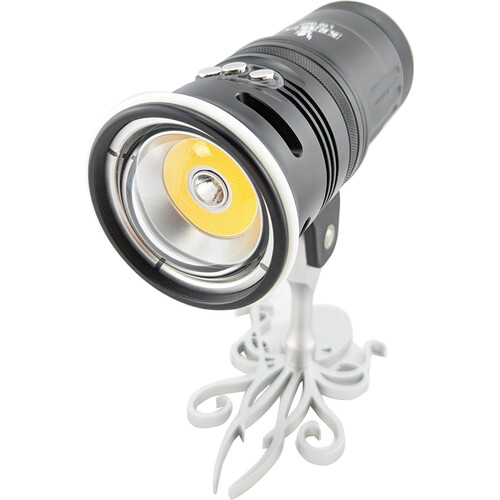
Kraken Sports LTD 10000: The Strong All-Rounder
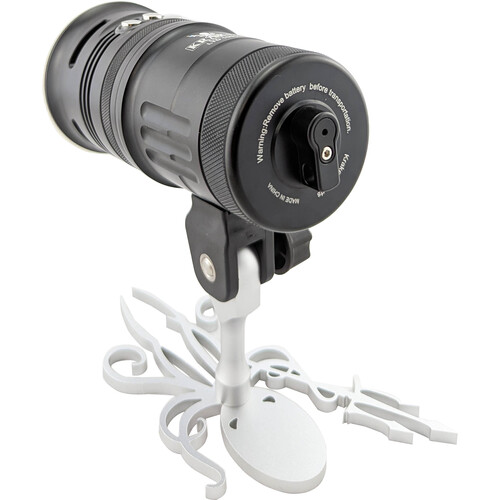
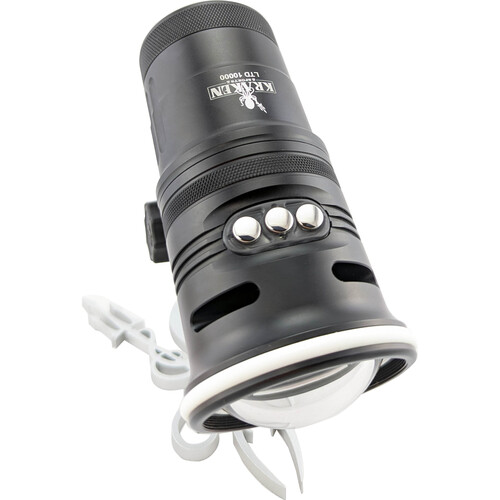
The Kraken LTD 10000 delivers 10,000 lumens in flood mode through a 100-degree beam angle, along with an additional 1,500-lumen spot beam with a 15 degree beam width. This dual-functionality allows for the ability to simultaneously illuminate a broad area for video purposes and then easily transition into a narrow-spot beam to focus-in on a specific object or subject detail without having to change-out lights. Since the CRI is 90, the color accuracy is adequate, and due to its COB LED configuration along with a domed front element, the output is smooth and even with minimal shadowing artifacts common among less expensive multi-LED configurations.
The light is certified for operation at 100 meters (328 feet), thus covering nearly all recreational diving operations and most technical diving operations as well. The light can be charged via USB-C, representing an excellent advancement beyond the proprietary charging methods used by many manufacturers today. Additionally, the light includes both YS-mount and 1" ball-mount adaptors, allowing compatibility with all major arm systems.
While the weight of 910 grams isn't exactly negligible, that's the trade-off for providing 10,000 lumens at a depth rating of 100 meters. The 40-hour runtime specification is impressive at first glance, though that figure most likely pertains to the lowest brightness setting. You can also check pricing on Amazon if you want to compare.
One noteworthy feature worth mentioning is the fiber optic port that enables using the LTD 10000 as a strobe trigger. If you're capturing both stills and video during the same dive, that convenience factor is substantial. Furthermore, the Kraken LTD 10000 is compatible with Kraken's remote control system, enabling brightness adjustments without removing your hands from the camera.
Alternative Options Worthy of Consideration
While the Kraken LTD 10000 represents an excellent choice, there are other alternative options worth considering depending upon your budget and specific requirements related to your type of shooting.
SeaLife Sea Dragon 2500
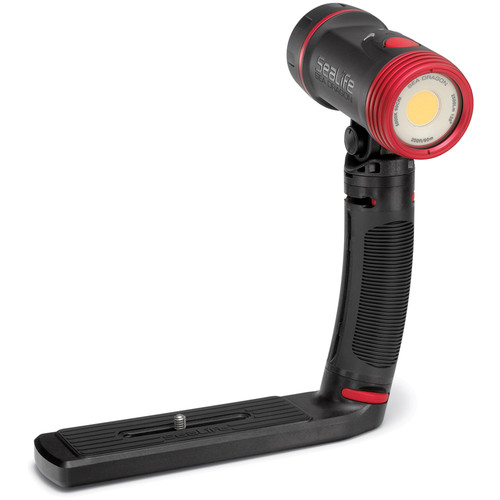
The SeaLife Sea Dragon 2500 has been around for quite awhile and there's good reason for its ongoing popularity. It delivers 2,500 lumens with a beam angle of 120-degrees, which is actually wider than the Kraken's flood mode. That extra 20 degrees of coverage does make a noticeable impact during wide-angle video work. Its color temperature of 5000K with a CRI of 90 ensures color accuracy is on par with the Kraken.
Three selectable brightness levels (625, 1250, and 2500 lumens) offer a reasonable amount of versatility, while runtimes span from 60 minutes on maximum to 240 minutes at minimum power. It ships complete with a tray and grip system, which is a welcome inclusion considering how quickly accessory costs accumulate.
The primary disadvantage of the Sea Dragon is its limited operating depth rating of only 200-feet (60-meters). Therefore, while it is suitable for recreational diving, it does limit your ability to perform deeper dives. It's also available on Amazon for comparative pricing purposes.
Bigblue CB33000P
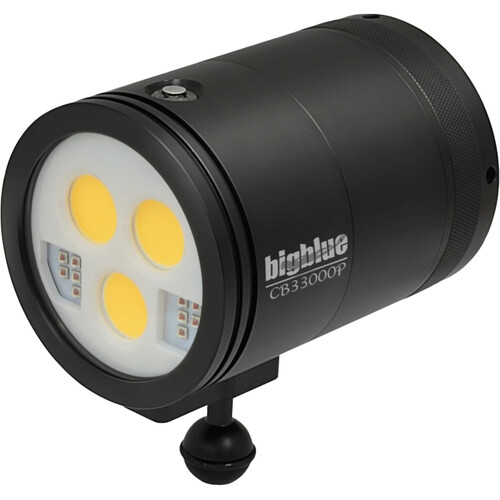
If you require extremely high output, the Bigblue CB33000P is capable of producing an astonishing thirty-three thousand lumens through an ultra-wide angle of 160-degrees. This excessive amount of light is intended for use in professional underwater cinematography where extensive areas must be illuminated or where shots need to be captured at substantial depth.
Another notable advantage of this product is that its color temperature can be adjusted anywhere within a range of 2700K to 6500K, providing users with flexibility to either match ambient conditions or create distinct effects.
In addition, Bigblue incorporated red LEDs into the product for focusing assistance as well as blue LEDs for fluorescence diving, which is a specialized but increasingly popular form of underwater video. While the CRI is 85, slightly lower than the Kraken and SeaLife, the raw light output combined with the color temperature adjustability compensates for that difference in most real-world situations. The price point clearly positions it for professional use, and it would certainly be excessive for typical reef footage.
Movo LED-WP
The Movo LED-WP represents the entry-level option at a considerably lower price point. It produces 700 lumens of 5500K light, which won't illuminate an entire reef wall, but it provides adequate light for close-up work and macro video. Weighing just 153 grams, it's significantly smaller than everything else discussed here, and its cold shoe mount allows for direct attachment to a compact camera housing without the need for a full arm system. The inclusion of white, orange, and purple diffusers is a considerate addition at this price range.
The depth rating of 130-feet (40m) restricts you to shallower dives, and the 80-minute runtime on maximum output is rather tight for a full dive. But as a starter light or a backup, the value proposition is strong. You can browse more underwater video lights at B&H to compare options.
Practical Tips for Underwater Video Lighting
Purchasing the right light is only part of the equation. Learning to use your footage effectively is equally important.
Positioning and Backscatter
The largest error made by new underwater videographers involves attaching their light adjacent to their lens and pointing it directly forward. This illuminates every particle in the water column between you and your target subject, creating backscatter that resembles snowflakes falling everywhere on screen. Conversely, position your lights out to each side of your camera on arms, angling them slightly inward toward your target subject. This moves the illuminated water column out-of-frame.
Generally speaking, for wide-angle videos, you want your lights positioned as far away from each other as possible. Typically, a dual-light arrangement consisting of each light mounted six-to-eight inches away from your camera works well for most types of shooting scenarios. For macro and close-up videos, you can move your lights closer together since backscattered light has less impact at shorter distances. If you're shopping for lighting kits for film work in general, the principles of light positioning apply above water too.
Battery Management
Cold water causes batteries to deplete more rapidly, so whatever runtime the manufacturer specifies, anticipate approximately 20-30% less in cold water environments. Always begin each dive with fully charged batteries, and consider bringing along a spare light as backup. Few things can ruin an underwater video shoot faster than losing your primary light source at depth. USB-C charging, like the Kraken offers, simplifies recharging between dives since you're probably already carrying a USB-C cable for your camera and monitor.
Matching Your Light to Your Camera
If you're shooting with a GoPro or action camera in a shallow reef environment, the Movo LED-WP is probably sufficient. Its compact form factor and cold shoe mount pair naturally with smaller housings. For mirrorless cameras in proper dive housings, the SeaLife or Kraken class of light makes more sense, both in terms of output and the arm/tray mounting systems they use. And if you're doing professional underwater cinematography work, the Bigblue's output and color temperature control justify the investment.
Frequently Asked Questions
How many lumens do I need for underwater video?
For close-up and macro work, 700-1500 lumens is usually enough. For general reef and wide-angle video, you want at least 2500 lumens. Professional underwater cinematography often uses 10,000 lumens or more to maintain proper exposure at depth. The Kraken LTD 10000 will cover virtually all your video needs.
What is the ideal color temperature for underwater video?
Optimal color temperature for underwater video should approximate natural daylight at approximately 5000-5500K. This represents optimal blending with surrounding ambient light in shallower waters. Some lights like the Bigblue CB33000P offer adjustable color temperature, which is useful for deeper dives where you want warmer tones to counteract the blue shift.
Can I use regular LED panels underwater?
Absolutely not. Standard LED panels are neither pressure-resistant nor waterproof. Specialized underwater video lights have been developed and incorporate sealed housings that can withstand pressures associated with diving depths. Even lights rated as "waterproof" for surface use won't survive the pressure at depth.
How can I prevent backscatter in underwater video?
Attach your lights out to each side of your camera on arms extending outward at angles slightly inward toward your subject, so that any illuminated particles are outside of your camera's line-of-sight. Wide beam-widths (100 degrees or more) further reduce backscatter issues as the light disperses rather than concentrating into a beam that highlights suspended matter. Our guide on filmmaking lights covers more positioning techniques.
Is one light enough for underwater video?
A single light can produce acceptable results for close-up and macro work. However, for wide-angle video, two lights are highly recommended. One light alone creates uneven illumination and harsh shadows, particularly on larger subjects. Most dedicated underwater videographers operate a dual-light setup on a tray and arm system, like the one included with the SeaLife Sea Dragon 2500.
Do I need a red filter if I have video lights?
If your lights are sufficiently powerful to serve as the primary light source at your working distance, a red filter is unnecessary. Red filters are designed to correct ambient light in shallow water when artificial lighting is not being used. Combining a red filter with video lights will result in overly warm and oversaturated footage. Choose one approach or the other based on your setup.