Best Lenses for Real Estate Video That Actually Go Wide Enough

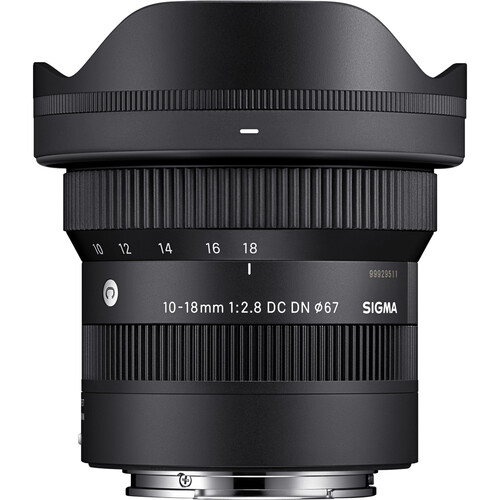
Real estate video has a single non-negotiable requirement that sets it apart from all other types of video work: you need to be able to film "wide." Very wide. Wide enough to get the feel of being in a reasonably sized bathroom (even though it may appear to be a little cramped), and wide enough to make a small kitchen seem large and welcoming. This requires the use of an ultra-wide-angle lens. If you're filming on an APS-C mirrorless body, which most real estate videographers do, then the Sigma 10-18mm f/2.8 DC DN Contemporary is the best ultra-wide-angle lens available.

Choosing the right ultra-wide-angle lens however is more than simply choosing a lens based upon its focal length. In addition to providing a broad angle of view (in order to capture an entire interior space), the lens should provide minimal distortion, rapid focusing capabilities (for walk-through sequences), and should cost less than most agents would pay for each property listing price (which can barely cover gas expenses). Additionally, the lens needs to perform well on a gimbal, so weight is a more important consideration than you might initially think.

Sigma 10-18mm f/2.8 DC DN side angle

Why Ultra-Wide Matters for Real Estate

If you have attempted to shoot a bedroom with a 24mm lens, you already understand the issue. On a full frame camera, a 24mm focal length is considered wide. However, within a 10x12 room, only about a third of the space is visible, and the listing agent is going to ask as to why the room appears so small. To create the illusion of interior space without making every wall appear distorted like those found within a funhouse, you'll need an ultra-wide-angle lens that provides approximately 10-16mm on APS-C (approximately 15-24mm on full frame).

For real estate walk-through sequences, the optimal focal length is generally between 10-12mm on APS-C. At this focal length, you can record an entire room from a doorway while maintaining relatively straight vertical lines. When recording at focal lengths wider than 10mm, you begin to fight barrel distortion that may only partially be corrected by utilizing lens correction software. Conversely, when recording at focal lengths narrower than 16mm, you will find yourself frequently backing into walls in an attempt to include everything within your frame.

This is also why rectilinear lenses are important here. Fisheye lenses are capable of achieving extremely wide angles similar to those achieved with rectilinear lenses. However, fisheye lenses distort straight lines, making them inappropriate for architectural applications where you want walls, doors, and countertops to appear straight. All of the lenses covered within this article are rectilinear, meaning that straight lines remain straight (for the most part).

Sigma 10-18mm f/2.8 DC DN: The Top Pick

The Sigma 10-18mm f/2.8 is a compact APS-C lens that covers the exact focal range required by real estate shooters. At 10mm (15mm equivalent), you can capture entire rooms from the doorway. At 18mm (27mm equivalent), you can zoom in for detail shots of countertops, fixtures, etc., without needing to swap lenses.

Sigma 10-18mm f/2.8 DC DN rear mount view

Key Specs

  • Focal length: 10-18mm (15-27mm equivalent on APS-C)
  • Maximum aperture: f/2.8 constant
  • Weight: 9 oz / 255g
  • Filter size: 67mm
  • Minimum focus distance: 4.6 inches
  • Available mounts: Sony E, Canon RF, Fujifilm X

The constant f/2.8 aperture is actually a larger factor than it might initially seem for real estate. Real estate shooters typically film interiors with various lighting levels, windows tend to blow out, and there are often areas of low light in corners. Utilizing an aperture of f/2.8 allows more options before raising the ISO, or lowering the shutter speed below what's acceptable for handheld walk-through sequences. Most competing ultra-wides in this focal range stop at f/4 or slower, resulting in increased ISO values or reduced shutter speeds.

What B&H Reviewers Say

B&H reviewers have praised the sharpness and compact nature of the lens repeatedly. One reviewer even used it for their own real estate interior photography on their Sony A6700 and stated the image quality was fantastic.

Several reviewers have commented on the lightweight design of the lens, specifically for gimbal usage. The lens weighs only 9 oz., allowing your rig to maintain balance without additional counterweights.

The reviewers state that the autofocus is both fast and reliable, an important feature when recording walk-through sequences in various locations.

A few reviewers did mention some negatives regarding the lens. Specifically, two reviewers commented on the absence of optical image stabilization. While IBIS within your camera body, or a gimbal can compensate, it is something to consider if you plan on doing a lot of handheld work. Another reviewer noted the absence of an aperture ring, which shouldn't bother most real estate videographers but is worth noting if you prefer manual aperture control.

The Sigma is also available in Canon RF and Fujifilm X mounts, and you can compare prices on Amazon too.

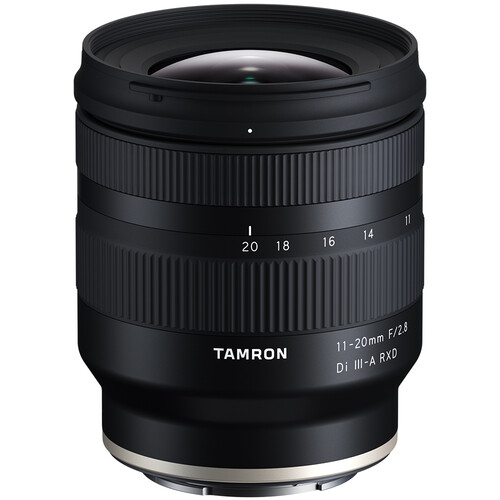
Tamron 11-20mm f/2.8 Di III-A RXD: The Close Runner-Up

Tamron 11-20mm f/2.8 Di III-A RXD lens

The Tamron 11-20mm f/2.8 is the other fast ultra-wide zoom that real estate videographers return to time and again. It has been available longer than the Sigma, so there is a larger pool of real-world experience from working professionals.

The Tamron starts at 11mm rather than the Sigma's 10mm, which translates to approximately 16.5mm equivalent versus the Sigma's 15mm equivalent. While a 1.5mm difference at the extreme wide end appears negligible, when combined with the limited space of a small bathroom, it can literally be the difference between capturing an entire room vs. missing a portion of it. On the opposite end, the Tamron reaches 20mm (30mm equivalent) offering slightly more reach for exterior shots.

Additionally, the Tamron possesses a shorter minimum focus distance compared to the Sigma. This allows for those detail shots agents adore: close-ups of hardware, tile work, kitchen appliances etc.

Build quality is solid, autofocus is silent and ideal for video recording, and it utilizes 67mm filter threads similar to the Sigma.

However, Tamron's version is slightly heavier and larger than Sigma's version. While this difference does not impact tripod-based filming, it does impact smaller gimbals such as those offered by DJI (e.g., RS series). If you're shooting with a gimbal stabilizer, every ounce counts. The Tamron 11-20mm is also available on Amazon if you prefer to shop there.

Canon RF-S 10-18mm f/4.5-6.3 IS STM: Budget-Friendly with IS

Canon RF-S 10-18mm f/4.5-6.3 IS STM lens

The Canon RF-S 10-18mm takes a whole different route. While it may not give you the lowest ISO options (you won't be winning any low-light battles with f/4.5-6.3), it does have two things that neither the Sigma nor Tamron do: built-in optical image stabilization, and at a price that won't blow your budget.

As a Canon RF shooter looking to film real estate, there is no other natively available ultra-wide option that isn't going to cost a small fortune. Plus, the fact that the lens includes built-in IS along with the IBIS provided by your Canon body (as long as your model has it), allows for handheld filming to remain relatively stable even at slower walking speeds. Since you're usually the one-person crew doing walk-throughs without a chance to set up a gimbal, stability is what matters most.

The Downside

The biggest drawback to using this lens is the variable aperture. At 18mm, you'll be shooting at f/6.3, which means that you need plenty of ambient light or your ISO is going to start getting pushed into noisy territory. For well-lit daytime shoots, this is not a major issue. For twilight exterior shoots or those moody interior shots, you'll feel the limitation quickly.

The STM motor handles autofocus adequately for video purposes but lacks the smoothness and confidence of focusing systems found on the Sigma and Tamron. While performing slow and deliberate walk-throughs, it works well enough. However, if you're producing faster paced content with more frequent focus transitions, occasional autofocus hunting may appear in your finished product.

Sony FE PZ 16-35mm f/4 G: The Full-Frame Option

Sony FE PZ 16-35mm f/4 G lens

If you're filming on a full-frame Sony body like the A7 III or A7 IV, the Sony FE PZ 16-35mm f/4 G is well worth considering. The "PZ" stands for power zoom, which provides smooth motorized zoom transitions that look significantly more professional than manual zoom pulls during walk-throughs.

At 16mm on a full-frame sensor, you get a field of view roughly equivalent to 10-11mm on APS-C. Not quite as wide, but certainly wide enough for most rooms.

The power zoom is really the biggest selling point here. You can transition from a wide room shot to a detail of the fireplace mantle in one smooth, continuous take. That kind of production value separates professional real estate video from the shaky iPhone clips most agents are uploading.

The lens is also very compact for a full-frame 16-35mm, weighing just over 12 ounces. It works beautifully on gimbals and features internal focusing, so the lens doesn't extend while focusing (important for gimbal balance). On a full-frame sensor, an f/4 aperture translates into approximately one-stop more light gathering capability per pixel compared to an APS-C camera with an identical f/4 aperture. Therefore, while technically the Sony is one stop slower than both the Sigma and Tamron, the difference in terms of actual low-light performance will appear significantly less dramatic.

How Wide Do You Really Need to Go?

This will depend largely on the types of properties you typically shoot and what your clients expect.

Small Apartments and Condos

To effectively capture entire rooms at doorway level (without fisheye distortion) you need to be able to achieve a focal length of around 10-12mm on an APS-C camera (or 15-18mm on full-frame). In very tight spaces, having as much room as possible at the wide end of your lens is essential. The Canon RF-S 10-18mm and Sigma 10-18mm both begin at 10mm, providing the greatest flexibility for you to work within those tighter spaces.

Standard Single-Family Homes

For standard single-family homes, 12-16mm on APS-C is usually sufficient. The rooms tend to be larger, meaning you don't need to push to the extreme wide end of your lens as frequently. Any of the lenses discussed in this article will handle these properties without issue. The Tamron's extra reach to 20mm is particularly useful for capturing exterior shots of the front of the house from across the street.

Luxury Properties and Commercial Spaces

Larger spaces are actually easier to capture in some respects because you have room to back up. But clients paying for luxury video expect smoother camera movement and more polished transitions, which is where the Sony PZ 16-35mm's power zoom really shines. The best video tripod or gimbal paired with a power zoom lens gives you broadcast-quality movement that justifies higher rates.

Gimbal Compatibility and Weight

Real estate video almost always involves walking through the property, which means either a gimbal or really good IBIS (ideally both). Lens weight directly impacts which gimbals you can use and how long you can shoot before your arm gives out.

The Sigma 10-18mm at 255g is the lightest option on this list and works on basically any gimbal, including smaller units like the DJI RS 3 Mini. The Tamron is slightly heavier but still manageable. The Canon RF-S is similarly lightweight. The Sony 16-35mm PZ, while compact for its class, adds up when paired with a full-frame body that's already heavier than an APS-C setup.

If you're doing multiple listings in a day (and most real estate videographers are), total rig weight becomes an important consideration. Combining an APS-C body like the Sony A6700 with the Sigma 10-18mm yields a total package weight under two pounds (body + lens). That's a combination that can be easily carried all day without fatigue.

For more on lens choices for video, we've covered the broader landscape in a separate guide. And if you're shooting weddings alongside real estate work, the priorities shift quite a bit.

Frequently Asked Questions

What is the best focal length range for real estate video?

For interior filming on APS-C cameras, 10-12mm (equivalent to around 15-18mm on full frame) is the sweet spot for general interior scenes. Using this range will allow you to capture most rooms from doorway level without significant fisheye distortion. Exterior views require longer focal lengths, anywhere from 16-20mm on APS-C. The Sigma 10-18mm f/2.8 has enough range to cover both bases.

Do I need a full-frame camera for real estate video?

Not at all. APS-C cameras like the Sony A6700 or Canon R7 paired with a proper ultra-wide lens deliver excellent real estate video. While full-frame cameras offer superior low-light performance and shallower depth of field, they are unnecessary for producing great real estate video. For real estate where you want everything sharp and you're mostly shooting in daylight, APS-C is perfectly fine and keeps your total kit cost lower.

Is optical image stabilization important for real estate lenses?

It helps, especially if you're shooting handheld without a gimbal. The Canon RF-S 10-18mm is the only lens on this list with built-in OIS, which combined with in-body stabilization makes handheld walk-throughs smoother. But most serious real estate videographers use a gimbal anyway, which makes lens-based IS less critical.

Can I use a fisheye lens for real estate video?

You can, but most agents and viewers prefer the natural look of a rectilinear ultra-wide. Fisheye lenses curve straight lines (walls, door frames, countertops), which looks unnatural in architectural contexts. Some videographers use fisheye with software defishing, but you lose resolution at the edges and it adds a post-processing step to every project.

What is the difference between the Sigma 10-18mm and Tamron 11-20mm for real estate?

The Sigma goes 1mm wider at the short end (10mm vs 11mm), which matters in tight spaces. The Tamron reaches 20mm on the long end versus the Sigma's 18mm, giving you more range for exterior shots. Both share a constant f/2.8 aperture. The Sigma is lighter (255g vs the Tamron's heavier build), making it better for gimbal setups. Either one will serve you well for real estate, the choice often comes down to whether you value that extra width or extra reach.

Should I buy a zoom or prime lens for real estate video?

A zoom is almost always the better choice for real estate. You're moving through properties quickly and can't swap lenses between rooms. A zoom like the Sigma 10-18mm lets you go wide for room shots and zoom in for details without stopping. Prime lenses have their place in filmmaking, but real estate demands flexibility over absolute optical perfection.