Building Your First Film Lighting Kit Without Wasting Money
The biggest mistake filmmakers can make when purchasing their first film lighting kit is thinking there are only a handful of ways to do this. Every brand makes three product lines, and every light has multiple specifications that sound like they were written to confuse you on purpose. Fortunately, creating a 3-point lighting setup for narrative, documentary, and interview-style work does not require spending tens of thousands of dollars, nor does it require an engineering degree.
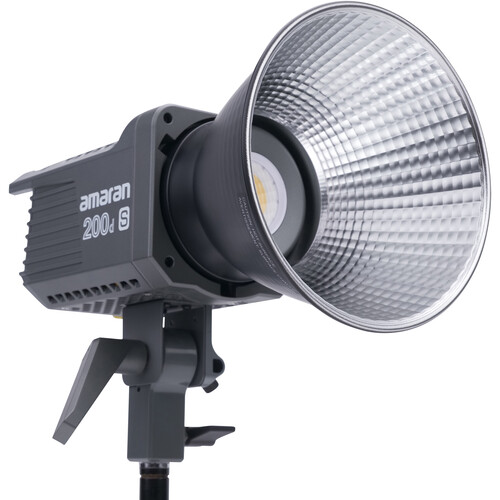
I'd recommend the amaran COB 200d S as the light for most filmmakers to begin with, due to its versatility as a starting key light. It's a 200W daylight-brightened LED monolight that has a CRI of 96, a TLCI of 99, and a Bowens S mount that opens up a massive world of potential modifiers.
Plus, it costs about as much as a decent tripod, so pair two or three of these with some simple modifiers and light stands and you've got a kit that will cover almost all your shooting scenarios without the guilt associated with overbuying equipment you don't need yet.
Three-Point Lighting Basics and Why It Still Works Today
For over forty years, three-point lighting has been the gold-standard for film and TV lighting. Key light, fill light, backlight. It's simple. It works. Understanding the three points will give you a solid base from which to launch your lighting career, even if you break all the rules later (which you should).
Key light is typically the brightest light in the shot, positioned at roughly a 45-degree angle to the subject. Fill light softens the shadow areas created by the key light, usually positioned directly across from the key light, but at a lower intensity. Backlight (sometimes called a hair light or rim light) separates your subject from the background, adds depth and dimension to an otherwise flat image.
What You Really Need to Get Started
Most people mess this up. They purchase a pre-made 3-light kit, including the lights, stands, soft boxes, etc., and figure they are done. While sometimes it works out, most times you are left with lights that are under-powered, soft boxes that fall apart after a use or two, and stands that are unstable.
As confirmed by B&H reviewers for the Godox SL150III 2-Light Kit, many users reported problems with the included stands snapping or breaking within a day of usage. Purchase the individual lights and select your own stands and soft boxes. You may have to research for longer, but you will get equipment that lasts.
The best lights for filmmaking guide covers more options across different price ranges. However, for a budget-conscious first kit, the Amaran S-series is difficult to beat.
The Amaran COB 200d S: Your Key Light
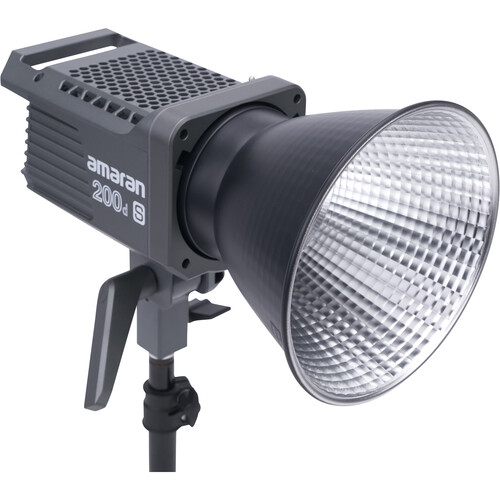
The amaran COB 200d S is a 200W daylight-balanced LED monolight that packs a punch far beyond its price category. It produces 55,800 lux at 3.3 feet using the included hyper reflector, which is plenty to light a single subject in a small to medium-sized area.
Without the reflector, the beam spreads to 110-degrees producing 7890 lux at the same distance, providing a wider and softer spread.
It is also noteworthy that the color accuracy for this type of price category is truly outstanding. CRI 96, TLCI 99, and an SSI of 87 at 5600K. That SSI number is especially noteworthy because it measures how similar the light is to true daylight, and the 87 is substantially better than the prior generation of Amaran lights.
This provides accurate skin tone representation and eliminates the need for extensive color correction during editing. As a comparison, the Aputure 300d is the high-end sibling in the Aputure lineup and costs a substantial amount more, so the 200d S offers the majority of that level of performance for a fraction of the cost.
What B&H Reviewers Are Saying
Users generally agree that the output for the money is excellent. One user who purchased four of these for a 12 x 12 studio noted he ran the lights at 25 percent brightness and used softboxes, which allowed him to keep the fans quiet and gave him plenty of room for error.
This is a practical consideration since fan noise is the one issue common to all LED monolights. At maximum power, the fans on the 200d S are quite loud according to that same reviewer. However, at moderate power and in auto-fan mode, they are completely unnoticeable. Another reviewer who also owns four of these commented that they produce zero noise and are very easy to control through the iPhone app.
Build Quality: Functional, Not Durable
While the amaran COB 200d S is functional, it is clear that the build quality is designed to be budget-friendly. The body is made of plastic, which reduces the weight to a manageable 3.44 pounds. However, as one reviewer pointed out, the plastic construction will likely not withstand repeated trips to the field location. In a studio environment where the lights remain mounted to stands, this is acceptable. In a run-and-gun production environment, you will need to provide protection for the lights.
Budget Option: The Amaran COB 100d S
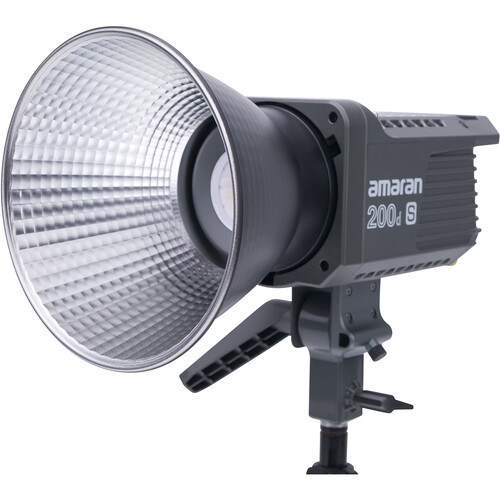
If the 200d S is outside of your budget at this time, the amaran COB 100d S is a smaller version of the same light at 100W. Like the 200d S, the 100d S has the same form factor, the same Bowens S mount, the same app control and nearly the same level of color accuracy (CRI 96, TLCI 99, SSI 86). The major difference is the level of output. With the included hyper reflector, the 100d S produces 34,600 lux at 3.3 feet, whereas the 200d S produced 55,800 lux at 3.3 feet. In a small home studio or for a content creator's setup, the 100d S produces plenty of light.

In terms of value, B&H reviewers have said the 100d S is a "great value" and have praised the fact that it dims all the way down to 1 percent, giving users a tremendous amount of flexibility from a single fixture. One reviewer described it as "super bright," and was particularly pleased with the ability to dim.
Creating a Kit Using the Amaran Platform
A practical starter film lighting kit built around the Amaran platform might look like this. Use two amaran COB 200d S lights for your key and fill, and one amaran COB 100d S for your backlight. The smaller light works well as a rim light, because you typically don't need as much output from the back light.
When you add up the cost of all three lights, you get a total investment that is approximately equivalent to the cost of a single Aputure Light Storm fixture, but you get a complete 3-light setup that will handle all of your interview, product photography, and basic narrative work. You can also compare lighting options across retailers to help determine the relative cost of each option.
Light Modifiers: What to Buy, and What to Avoid
One of the greatest sources of confusion for filmmakers when they first start shopping for lighting modifiers is figuring out exactly which ones they need, and which ones they can avoid. Here are the essentials.
Soft Boxes
A softbox is the most essential modifier. It takes a hard, sharp light from your COB and turns it into something that is flatteringly soft on faces. Since the Amaran lights both have a Bowens S mount, you have access to virtually all soft boxes available.
The Aputure Light Dome series is extremely well-regarded, but extremely pricey. The Aputure Light Storm modifiers are also well-regarded, but again, you pay a premium for the brand name. Most third party soft boxes for the Bowens S mount will do the job just fine, at a fraction of the cost of the Aputure options.
When choosing the best softbox for your key light, begin with the largest softbox in your size range (24-36 inches). Softboxes are preferred due to their ability to give you greater control over the amount of spill that occurs beyond your intended area of illumination. However, you do not necessarily require a softbox for each light in your kit.

What You May Not Need Right Away
Unless you are working on a highly specialized type of commercial project, you may not need barn doors. Snoots are unnecessary. Gobos are unimportant. Gel holder kits that include 47 colors you will probably never use are unnecessary.
In fact, for your first 50 shoots, you will likely only need to utilize a softbox on your key light, possibly a reflector or bounce card for fill light, and the bare reflector on your backlight. If you wish to add some color to your shoot, purchase a pack of CTO (color temperature orange) gels and a roll of diffusion. That is it. Do not get caught in the "accessory trap" and end up spending more money on accessories than you did on your initial lights.
Stands Matter More Than You Think
If your budget allows, purchase heavy-duty C-stands. They provide stability, support heavier modifiers without drooping, and last forever. If C-stands are too pricey right now, look for the heaviest aluminum stands you can afford and sandbag them. Lightweight stands are typically the first to fail, and a light falling off its stand onto talent during a shoot is not something you want to experience.
The Godox Alternative
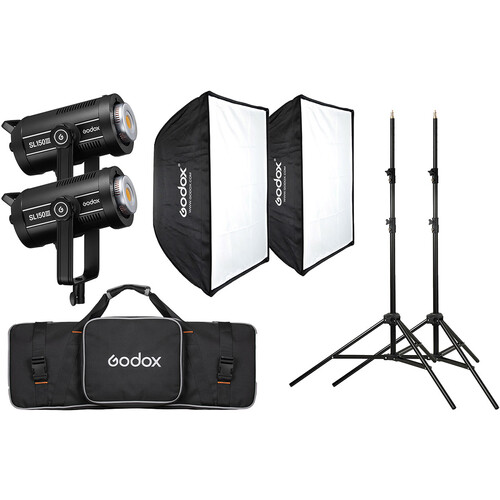
Godox is the other name that comes up constantly when discussing budget film lighting. The Godox SL150III is a 160W daylight LED that features CRI 96, TLCI 97, and features wireless app-based control. The Godox SL150III emits 58,000 lux at 3.3 feet, which is slightly higher than the amaran 200d S.
In addition to the SL150III, Godox offers a 2-light kit that contains two SL150III fixtures, two 23.6 x 35.4-inch softboxes with Bowens speed rings, two 6.6-foot light stands, and a rigid transport case. The convenience of buying everything in one package is a major draw.
However, the included stands in the kit have been criticized by some users for being less durable. Therefore, consider purchasing the kit for the lights and softboxes, but plan on replacing the stands.
Amaran vs. Godox
Choosing between Amaran and Godox is largely dependent upon your personal preference regarding ecosystems. Amaran utilizes the Sidus Link app (same as Aputure), whereas Godox uses their own control app. Both apps function properly.
Amaran's lights possess slightly better SSI scores for color accuracy, while Godox's fixtures often come with additional accessories. Both brands offer Bowens S mounts, which means that you can share modifiers between both brands. Regardless of your decision, neither brand will disappoint you.
Color Temperature: Daylight vs. Bi-Color
All of the lights mentioned in this article are daylight balanced at 5600K. This is intentional for a beginner's kit. Daylight balanced lights match window light, which makes shooting in mixed environments much easier.
If you anticipate shooting primarily indoors in locations lit with tungsten bulbs, you can gel your daylight LEDs with CTO (color temperature orange) to match the warm ambient light. It is cheaper to purchase a roll of gel than to buy bi-color fixtures. If you do a lot of corporate interview work where lighting varies between locations, Amaran manufactures a bi-color version called the 200c, which covers 2700-7500K.
Frequently Asked Questions
How much should I spend on a starter film lighting kit?
You can create a solid three-light setup for approximately the cost of a mid-range camera lens. Two amaran COB 200d S lights and one 100d S, along with stands and a softbox, will get you into the world of professional film lighting. The majority of the cost of creating a starter kit lies in the cost of the individual lights. Purchasing individual components versus an all-inclusive kit typically yields you higher quality gear for the money, although the total cost may be slightly higher. Check current amaran pricing at B&H to determine your budget.
Do I need bi-color lights or is daylight enough?
Daylight (5600K) is the most versatile starting point for lighting. You can always gel down to match tungsten lighting, but you cannot gel up to match daylight from a warm source. If more than half of your work takes place in mixed lighting environments, bi-color is worth the additional expense. Otherwise, you can begin with daylight lights and gel down to match tungsten lighting.
What is more important, CRI or TLCI?
CRI (Color Rendering Index) measures how accurately a light renders colors across a spectrum of reference samples. TLCI (Television Lighting Consistency Index) measures how colors appear on camera. While both are measurements of color accuracy, TLCI is more applicable to video work.
The amaran 200d S and the Godox SL150III both achieve CRI scores of 96+, as well as TLCI scores of 97+. These are excellent scores. Any light that achieves a CRI or TLCI score above 95 is considered professional grade. You can read more about how lighting affects your entire production in the best lights for filmmaking guide on this site.
Can I use these lights with a gimbal or handheld rig?
These are studio lights, not on-camera lights. They are meant to be used on stands and directed toward your subject or scene. For on-camera or gimbal-mounted lighting, you will need a small LED panel. Check the best on-camera monitor guide since many monitors pair with small LED panels in a rig setup.
Are V-mount batteries worth it for these lights?
Only if you frequently shoot in remote areas without access to AC electricity. The amaran COB 200d S requires the separately purchased 2-Bay Battery Power Station to attach V-mount batteries, and the batteries themselves are not inexpensive. For studio and most location shoots, the included AC power supply will suffice. If you shoot outside frequently, budget for the battery station and at least two 99Wh V-mount batteries. Browse V-mount battery options on Amazon for current pricing.
How loud are the fans on LED monolights?
Fan noise is the most common criticism found among all LED monolight reviews, regardless of the manufacturer. The amaran 200d S has an active cooling fan that becomes audible at full power. B&H reviewers suggest using the auto fan setting and running the light at moderate output, which keeps the fans quiet enough for most audio recording scenarios. If you are using a directional shotgun mic aimed at your subject and away from the lights, fan noise is usually not a concern.