Best Monopods for Video That Won't Let You Down on Set
What are some good monopods for video? And what are the pros and cons of a monopod versus a tripod for certain types of video work? The Manfrotto Xpro Video Monopod is the best monopod for video for most filmmakers, but there are solid alternatives at different price points worth knowing about.
Why a Monopod Beats a Tripod for Certain Video Work
Tripods have their advantages. They provide excellent support for locked-off shots. They're perfect for interviews. They keep the camera steady. However, they limit you. They require you to spread out your legs. They often need leveling. And setting them up takes longer. When you need to shoot in a smaller space, and you need to work faster, a monopod will serve you much better.
Monopods are perfect for run-and-gun shoots. They allow you to pan, tilt and reposition your camera quickly. There's no need to deploy your legs. No need to level. No need to adjust the head. They're perfect for working in tight spaces. Perfect for documenting events, such as weddings, conferences and live performances. They're perfect for capturing footage of subjects moving. If you're shooting with a heavier cinema rig, a monopod takes the load off your shoulders and lets you shoot for hours instead of minutes. And for those looking at other stabilization options, a gimbal covers different ground entirely.
But monopods have limitations. While you can get stability with a monopod, you can't get hands-free operation. You need to hold the monopod the entire time you're shooting. Smooth panning shots will also require a tripod with a proper fluid head.
In short, a monopod is the perfect compromise between stability and mobility. For most of your video work, a monopod with a fluid base will be the sweet spot.
Manfrotto Xpro Video Monopod: The Top Pick
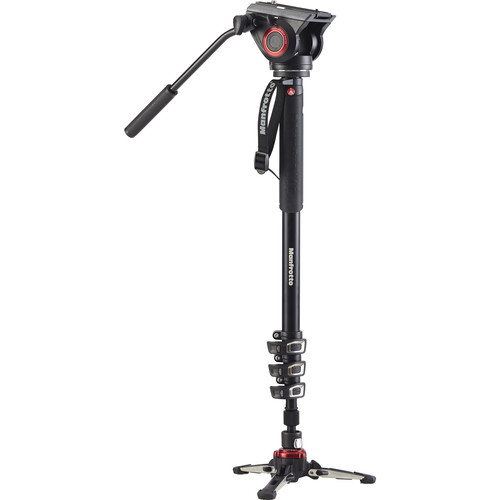
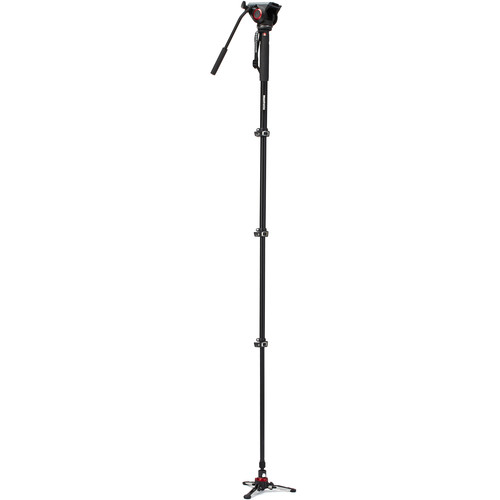
The Manfrotto MVMXpro500US comes with a 500-series fluid tilt head and Manfrotto's FluidTech base. In other words, this monopod offers a full solution for your video needs.
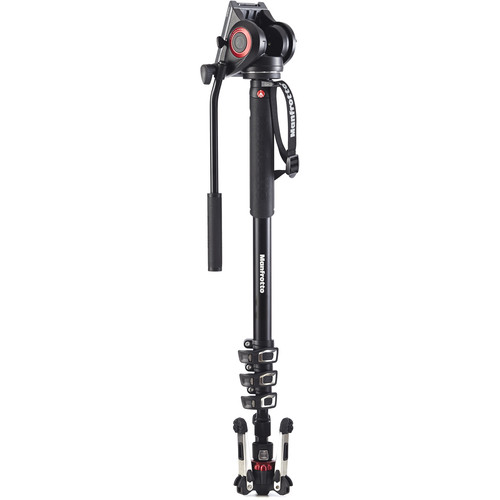
The FluidTech base is the standout feature. The FluidTech base utilizes a fluid cartridge. The fluid cartridge allows for smooth 360 degree panning and controlled tilting from a single pivot point. You can lock the vertical axis to isolate panning. This allows for level horizontal sweeps.
The 500 series head handles the forward and backward tilt with a counter-balanced mechanism. It has a side-mounted locking knob. With the combination of the FluidTech base and the 500 series head, you receive two axes of fluid motion. Both of these axes offer a fluid motion that feels almost identical to a true fluid head on a tripod.
In terms of build quality, the Manfrotto Xpro is built with a solid aluminum construction. Fully assembled, it weighs approximately 4.6 pounds. The Power-Lock flip locks snap open and shut quickly. The maximum height is approximately 80 inches, while the minimum height is approximately 31 inches. Therefore, it covers a wide variety of shooting heights.
The D-shaped leg sections help prevent twisting between each section. This is a problem many photographers experience with round-sectioned monopods. B&H customers frequently comment that the Power-Locks feel solid and the general feeling of build quality instills confidence even in heavy setups.
What Could Be Better
The biggest drawback is the fact that it is made of aluminum. As a result, it is heavier than a similar carbon fiber monopod. If you plan on backpacking to remote locations, or traveling light, the added weight may add up.
Additionally, the 500 series head is a good head but not the best. If you are planning on using a heavy cinema camera, you may eventually need to upgrade to a more substantial fluid head. Lastly, the FluidTech base provides temporary stabilization. It does not provide "true" free-standing capabilities. So, do not leave it unattended. You can also find the Manfrotto Xpro on Amazon if you want to compare prices.
iFootage Cobra 3: The Premium Choice
If you want a premium monopod for your video needs, then the iFootage Cobra 3 is the choice for you. Unlike the Manfrotto, the iFootage Cobra 3 is made of high-quality carbon fiber. The Cobra 3 features a pedal release mini tripod base and the K5S fluid head. The entire system is notably lighter and more refined than the Manfrotto.
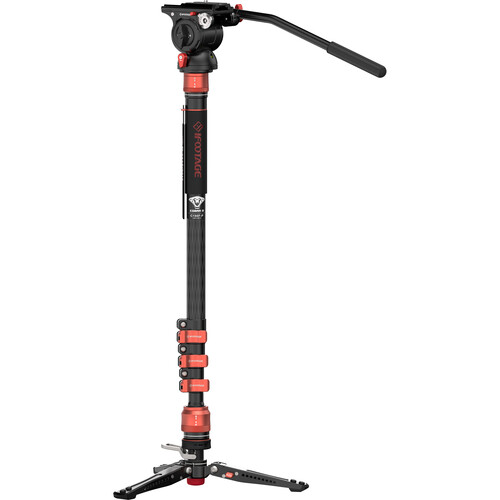
The pedal release mini tripod base is what really sets the Cobra 3 apart. Unlike a traditional monopod, where you must manually extend the legs by hand, the Cobra 3 allows you to step on a pedal and the legs automatically unfold. Press the pedal again and they fold back in.
At first glance, this seems like a minor improvement. However, when you are moving rapidly between positions at an event, being able to quickly deploy and retract the legs with your foot while keeping your hands on the camera is a huge advantage. The mini tripod base on the Cobra 3 also allows for better self-standing than the Manfrotto. However, do not rely solely on the monopod to hold your valuable equipment.
The carbon fiber design of the iFootage Cobra 3 greatly reduces the overall weight of the system. The K5S fluid head provides smooth pan and tilt with adjustable drag. The K5S fluid head performs well with medium-weight camera systems. The Manfrotto Element MII is another option if you want something from Manfrotto in carbon fiber, but the Cobra 3's pedal base gives it a real workflow advantage.
Neewer Professional Monopod: The Budget Pick
If you are new to monopod work and do not want to spend money on a professional-grade monopod, then the Neewer Professional Monopod with a fluid head is a great entry-level monopod.
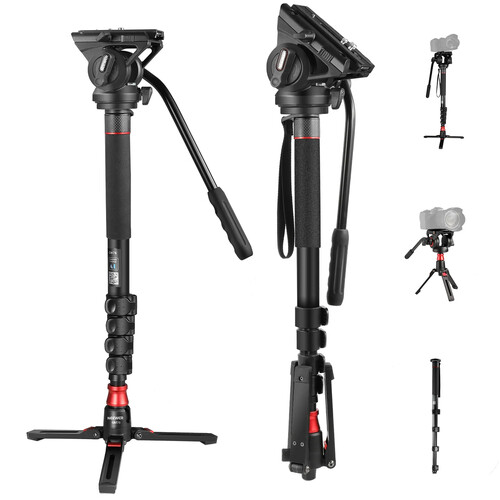
At a fraction of the cost of a professional monopod, the Neewer Professional Monopod covers the basics. The aluminum design is the first area where the Neewer falls behind. The locks are not as sharp as the Manfrotto or iFootage. The fluid head is not as smooth as either of those two options. Overall, the build quality of the Neewer is more budget-friendly.
That being said, the Neewer monopod still does a great job for videographers who simply need a reliable support system. It is a good option for students, amateur videographers, or as a second monopod to keep in your trunk. B&H reviewers say it works well with low-to-medium weight mirrorless systems, but with heavy rigs, it can feel a little unstable. You can also check the Neewer monopod on Amazon for additional options and bundle deals.
What to Look For in a Video Monopod
Not all monopods are created equally. Some of the features important for photography are not as important for video.
Fluid Base vs Standard Rubber Foot
A standard monopod has a rubber tip on the bottom. Great for photography. Terrible for video. A fluid base provides smooth rotation at the base. A fluid base provides the ability to pan and track subjects smoothly. For video, a fluid base is almost essential.
Weight Capacity and Balance
Check the manufacturer's specifications to ensure the monopod can handle the weight of your camera setup (including lenses and accessories). Most video monopods handle 8-15 pounds of weight with ease. Mirrorless and DSLR systems fall within this range. Heavier cinema systems require additional support. Consider a dedicated video tripod or a higher-end monopod.
Material: Aluminum vs Carbon Fiber
Monopods can be constructed from aluminum or carbon fiber. Aluminum monopods are heavier, but more affordable. Carbon fiber monopods are lighter, stronger and absorb vibrations more effectively. However, they are generally more expensive. If you plan on using your monopod for hours at events, the weight difference will become apparent. If you only pull it out once in a while, aluminum will suffice.
Frequently Asked Questions
Can you get smooth panning shots with a monopod?
Yes, if the monopod has a fluid base. The fluid cartridge in monopods like the Manfrotto Xpro allows smooth 360-degree rotation at the base. Lock the vertical tilt and you can do level pans that look close to what you'd get on a tripod. It's not as controlled as a dedicated fluid head on sticks, but for run-and-gun work it gets the job done.
Is a monopod better than a gimbal for video?
They solve different problems. A gimbal gives you smooth walking shots and dynamic camera movement. A monopod gives you stable, stationary support with the ability to reposition quickly. If you're shooting events where you stand in one spot for extended periods, a monopod is more practical. If you're doing a lot of walking and tracking, go with a gimbal. Many working videographers carry both.
What height should a video monopod be?
When fully extended, the monopod plus head plus camera should put the viewfinder at your eye level without you having to bend over. For most people that means a monopod with a maximum height between 65 and 80 inches. The Manfrotto Xpro maxes out at about 80 inches, which accommodates taller shooters. You can always shorten it, but you can't make a short monopod taller.
Do I need a separate fluid head for a video monopod?
Most video-specific monopods come with a fluid tilt head included. The Manfrotto Xpro includes a 500-series head, and the iFootage Cobra 3 includes the K5S head. These bundled heads are good enough for most shooting situations. If you're working with heavier rigs or want more precise drag control, you can always swap in a better head later since most monopods use standard mounting threads.
Are carbon fiber monopods worth the extra cost?
For working videographers who use a monopod daily, yes. The weight savings and vibration dampening make a real difference over long shooting days. For occasional use, aluminum monopods perform just as well at a lower cost. Consider how often you'll actually use it before spending extra on carbon fiber.
Can a video monopod support a cinema camera?
It depends on the monopod's weight capacity and the total weight of your rig. The Manfrotto Xpro handles setups in the 8-10 pound range comfortably. For heavier cinema setups with accessories, look at the iFootage Cobra 3 or consider a dedicated video tripod for more demanding situations where weight capacity matters most.