
Best Lens for Video: Why the Sigma 18-35mm f/1.8 Art Still Wins
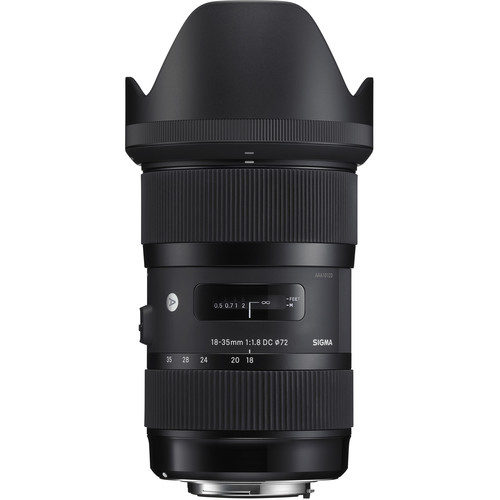
Picking the best lens for video is one of those decisions that can completely change how your footage looks and feels. However, many "best lens" articles simply list multiple options along with their specifications and leave it at that, which isn't particularly helpful if you're trying to decide which piece of glass to put on your rig for an actual shoot. While nothing is perfect, for APS-C shooters doing video work, one lens has essentially dominated the conversation for years now and that is the Sigma 18-35mm f/1.8 DC HSM Art.
What Really Matters in a Video Lens
To help with determining what makes a lens suitable for video rather than for stills, we need to consider what makes a lens good for each type of work. A lens' ability to maintain a constant aperture throughout the zoom range is much more important for video work. Maintaining a consistent aperture is important for video work because the exposure will remain constant whether you zoom in or out during a shot. As a result, you won't end up with an obvious exposure shift in the middle of a shot, and you'll spend less time correcting it in post-production. Another major concern for video work is having a smooth focus throw. In order to accurately pull focus by hand, the focus throw needs to be smooth and linear. If the focus ring snaps back and forth rapidly from one focus distance to another, then you can forget about pulling focus yourself, and you may need to rely on a follow focus unit to achieve smooth focus pulls.
Speed and Low Light
Having a fast maximum aperture (or being able to adjust to one quickly) gives you two advantages. The first is that you will be able to shoot in lower light conditions without increasing your ISO beyond acceptable levels. The second is that you will have a shallow depth of field, which creates visual separation between the subject and the background. These two factors are critical for creating visually interesting and engaging narrative work and interviews. They are also the difference between getting the shot and missing it altogether when light levels drop. For documentary and run-and-gun work, having that fast aperture is essential.
Construction, Ergonomics, and Durability
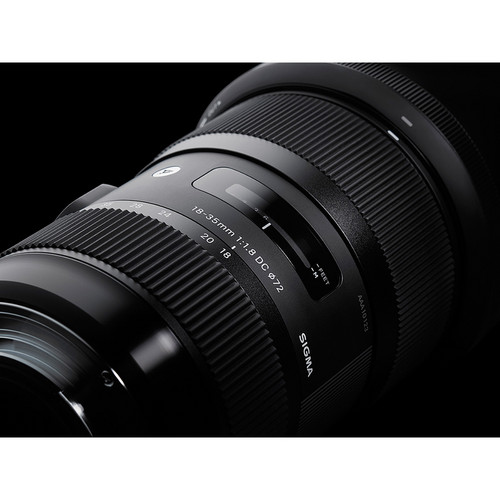
Video lenses tend to receive more physical punishment than still photography lenses, which makes durability an important consideration. Lenses mounted to gimbals, rigs, and follow focus units tend to experience a higher degree of mechanical stress than lenses mounted to a single fixed axis on a still camera. To minimize mechanical stress, lenses need to have smooth and consistent zoom and focus rings. Additionally, lenses that have poorly constructed or unergonomic bodies are likely to create issues when attempting to perform precise focus pulls on set.
Why the Sigma 18-35mm f/1.8 Art Wins Again
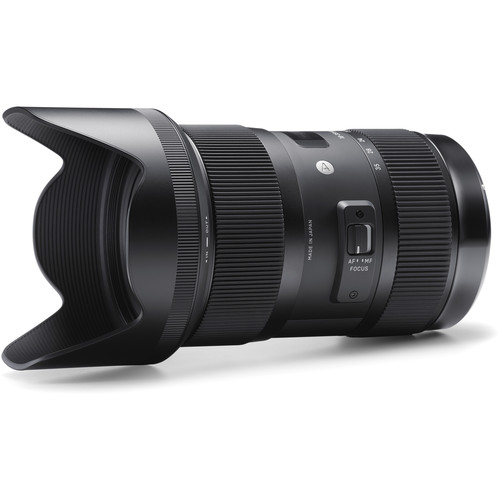
While the Sigma 18-35mm f/1.8 Art has been on the market for quite some time, it is still the lens that comes up most often when filmmakers discuss the best glass for APS-C video. As stated above, the reason for this is relatively straightforward: it is the only zoom lens in its class that has a constant f/1.8 aperture. A full-stop or more faster than any competitor, this constant aperture is a huge plus when it comes to video work. The 18-35mm focal length range on an APS-C sensor equates to approximately 28-56mm on a full-frame sensor, and is the most commonly used focal length for video production.
Reviewers on B&H consistently comment on the high-quality images produced by the lens. One reviewer, who paired it with his Canon T5i, called both the photo and video quality "outstanding". Another reviewer noted that the lens was virtually made for the Blackmagic Pocket Cinema Camera 6K Pro and said it remained sharp even when wide-open. Reviewers also report that it effectively replaces a large number of fast primes, providing a 28mm, 35mm, and 50mm equivalent lens in one piece of glass with minimal loss of quality.
Color Rendering
Several reviewers have praised the lens for its color rendering capabilities. One reviewer called out the rich, accurate colors of the Art series, stating that the reds and magentas were particularly impressive. Reviewers also report that the lens maintains good contrast even under difficult lighting conditions, and that it performs well against glare and backlight.
Important Specifications and Build Quality
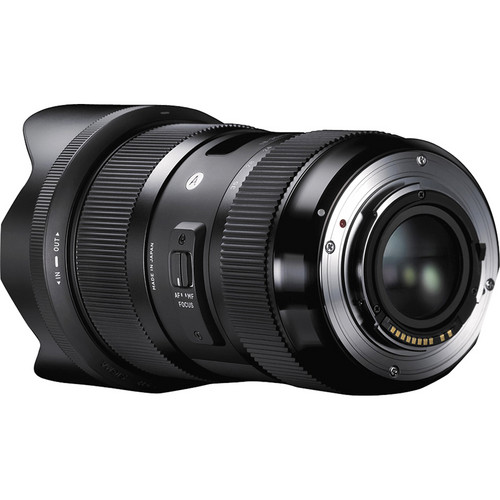
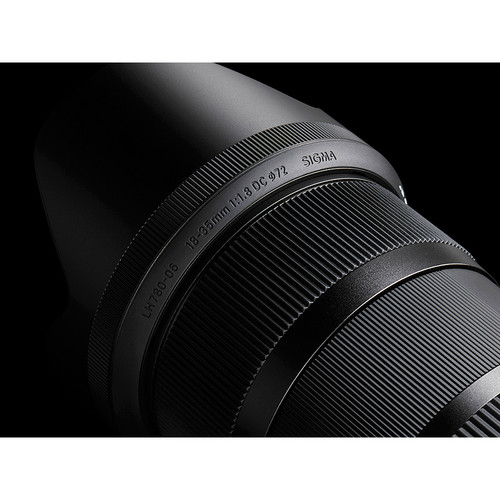
Here are the key specs of the lens. The optical design includes 17 elements in 12 groups, consisting of five SLD elements and four aspheric elements. This is a significant amount of special glass in the barrel of the lens, and it contributes to the overall image quality of the lens. The rounded diaphragm consists of nine blades, and produces a pleasing bokeh. The minimum focus distance is 28 cm, which is close enough for product shots and detail shots without needing to switch to a macro lens.
Weight
This lens weighs 810 grams (approximately 1.78 pounds). You will certainly feel this weight on smaller mirrorless bodies, and it will add up quickly if you're running this lens on a gimbal all day. However, B&H reviewers report that the balance of the lens feels surprisingly good once it is on the camera, and that the build quality is professional-grade. The lens features a Thermally Stable Composite body and a brass mount, which contribute to a durable and high-quality feel.
Autofocus Performance
The Hyper Sonic Motor in this lens is capable of autofocus for photography purposes, and performs reasonably well for that purpose. However, video shooters need to understand that this is not a fast or quiet autofocus system, and it is not ideal for continuous autofocus in video applications. Multiple reviewers on B&H have reported that the autofocus motor is slow and loud compared to autofocus motors found in native mirrorless lenses. One reviewer specifically reported that the lens hunts and that it is not for beginners. Most experienced video shooters will be pulling focus manually in any case, and the focus ring is smooth enough for that. However, if you are relying on continuous autofocus for run-and-gun video, you will find this lens frustrating. The lens does not feature optical image stabilization, so you will be forced to depend on your camera's IBIS or a gimbal stabilizer to stabilize your footage.
What B&H Users Have Said
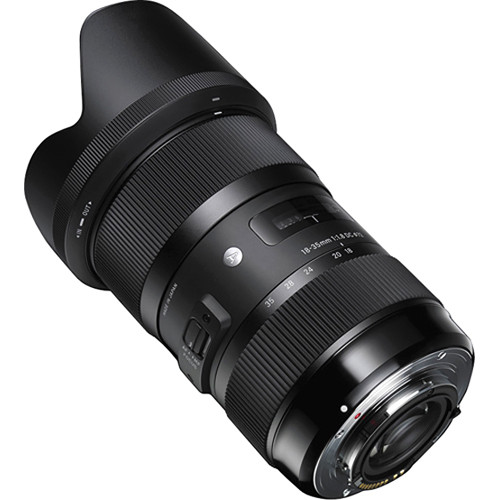
With over 660 reviews and a 4.7 average rating on B&H, this lens has developed a reputation among videographers. However, the reviews paint a more detailed picture of the lens than the star rating alone.
Pros
Users consistently report that the lens produces extremely sharp images, even when wide-open at f/1.8. Multiple reviewers describe it as producing comparable or superior image quality to lenses that cost significantly more, and several have called it the best APS-C lens they have ever owned. The constant f/1.8 aperture is specifically praised by users as a huge advantage for video work, since it ensures that you will never experience exposure changes due to zooming. Users have reported excellent results using the lens for video production on the Blackmagic Pocket Cinema Camera line, Canon crop bodies such as the 7D Mark II, R7, and others.
Cons
Users have complained repeatedly about the noise produced by the autofocus motor. Specifically, users who previously worked with newer native mirrorless lenses that produce almost no audible autofocus motor noise have been surprised by the level of noise produced by the Sigma lens. While this is unlikely to be a show-stopper for most video work (since you would normally use manual focus), it is certainly something to be aware of. Because the lens is APS-C only, it cannot be used on full-frame cameras without severe vignetting, which may limit the lens's usefulness in the future if you are considering upgrading to a full-frame camera. Finally, the lens does not contain optical image stabilization, which is becoming increasingly common in this price range, although many high-end cinema lenses do not include optical image stabilization either.
Other Options to Consider
While the Sigma 18-35mm f/1.8 is our top recommendation, there are other options worth considering. If you are shooting full-frame, the Tamron 17-35mm f/2.8-4 is a lighter, more affordable alternative, albeit with a variable maximum aperture of f/4 at the widest angle. For Sony shooters, the Sony FE 35mm f/1.8 is a highly-regarded prime lens that produces exceptional autofocus performance on native mirrorless bodies.
For those seeking a wider angle of view, the Laowa 10-18mm is a viable option for capturing those dramatic wide-angle establishing shots. At the high end of the spectrum, cinema-specific zoom lenses from manufacturers such as Canon (Canon CN-E series) or Sigma's own Cine series provide superior focus mechanisms and parfocal designs, however, they come with a higher price tag. For most independent filmmakers and content creators, the Sigma 18-35mm f/1.8 Art offers the right balance of image quality, speed, and price to justify its inclusion in your kit.
You can check current pricing on the Sigma 18-35mm at B&H Photo or compare prices on Amazon.
Frequently Asked Questions
Can I use the Sigma 18-35mm on a full-frame camera?
Technically yes, it will mount on a full-frame Canon EF body. However, since it was designed for APS-C sensors, you will experience severe vignetting (the darkening of the corners of the frame) on a full-frame sensor. Some cameras have a crop mode that can bypass this issue, but you will lose a considerable amount of resolution by using the lens in crop mode. It is best to keep it on APS-C bodies like the Canon 7D Mark II, 90D, R7, or Blackmagic cameras that utilize a Super 35 or similar-sized sensor.
Is the Sigma 18-35mm good for filmmaking?
One of the most widely-used lenses in indie filmmaking, the Sigma 18-35mm is the lens that filmmakers rave about, and it is easy to see why. The constant f/1.8 aperture, high-quality optics, and versatile focal range make it a staple for narrative, documentary, and commercial productions. B&H reviewers who have used this lens for video production rave about it. The only potential downside is that the autofocus system is not optimized for video applications, so you will likely be pulling focus manually or using a follow focus system. You can check current availability on Amazon or see it at B&H Photo.
Which cameras does the Sigma 18-35mm work best with?
The Sigma 18-35mm f/1.8 DC HSM Art is available in Canon EF and Nikon F mounts and can easily be adapted to other formats (such as Sony E-mount, Micro Four Thirds, etc.) through adapters like Metabones or Sigma MC-11. B&H reviewers have reported excellent results using the lens on the Blackmagic Pocket 6K Pro, Canon R7, Canon T5i/T7i, and Canon 90D. With adapters, the lens can also be used on Sony E-mount cameras like the FS5 and A6 series bodies, and Micro Four Thirds bodies, although the crop factor will reduce the effective zoom range on these platforms.