Aputure Light Storm: A Closer Look at the LED Lineup
There are many reasons why the Aputure Light Storm series has made a name for itself on film sets. If you've worked on an indie film in the last five years, chances are you've seen a Light Storm fixture on a C-stand somewhere in the distance. The Light Storm series includes a variety of models ranging from the smallest LS 120d II to the largest LS 1200d Pro, and more recently Aputure released the STORM series as the next generation of the entire product line.
Aputure did something unique to make the Light Storm series worth discussing, they created a system. Since every Light Storm fixture uses the same Bowens S-mount, all of your softbox attachments, fresnel attachments, barn door attachments and dome attachments will swap between lights without having to purchase additional accessories. Cross-compatibility is very important when building a lighting package because you may be purchasing multiple lights and accessories over a period of time.
The Sidus Link app allows you to connect to the Light Storm fixtures wirelessly using Bluetooth. Once you get beyond the first connection to the app, it works surprisingly well.
Light Storm Models by Model Number
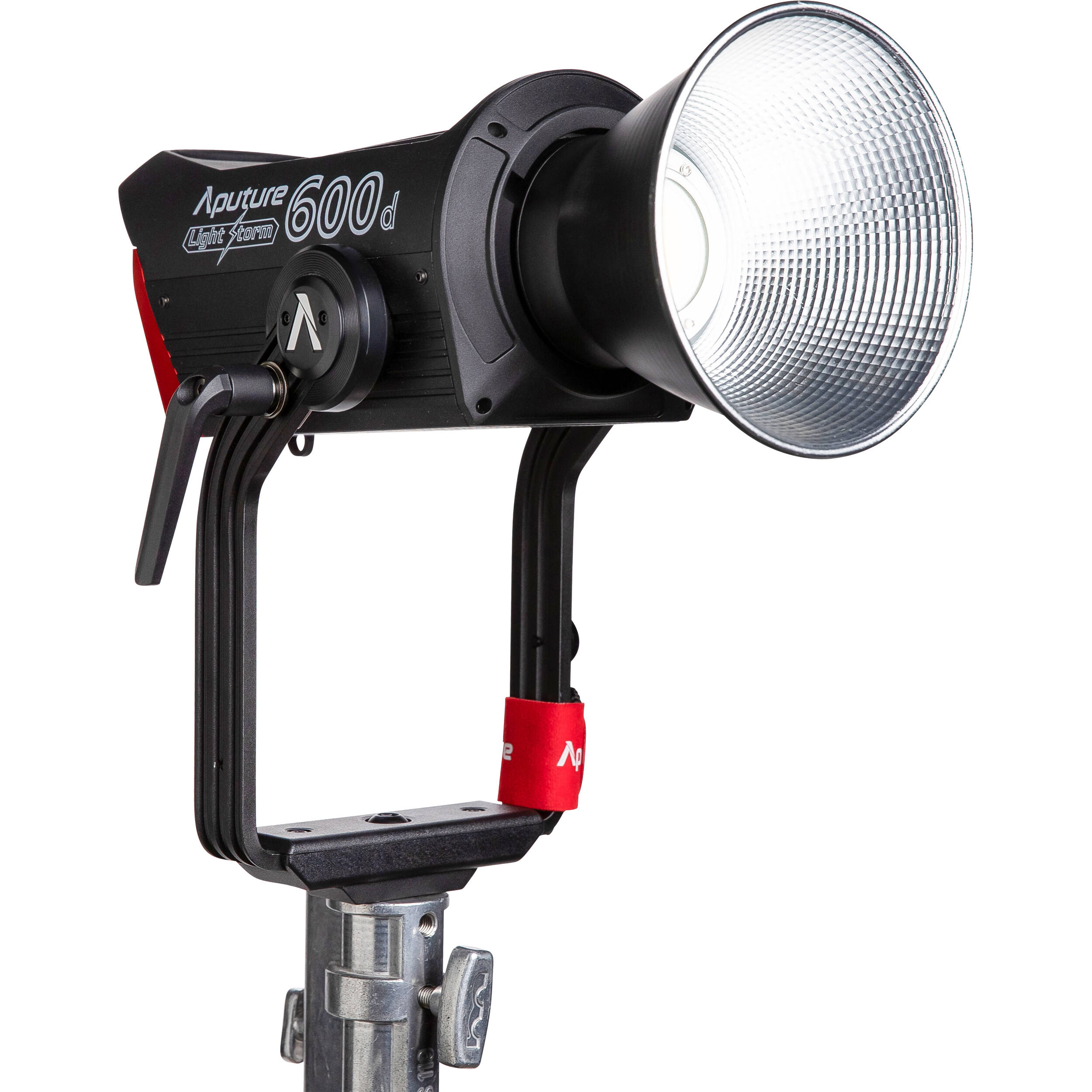
Most of the information you'll need to know about each model of the Light Storm can be determined from the model number. The number in the model number represents the wattage of the fixture, and the letter after the number indicates whether the fixture is capable of producing any other color temperatures besides daylight (5600K). A "d" means daylight only. An "x" means the fixture is capable of producing any white color temperature (bi-color) between 2300K and 6500K.
And a "c" after the number means the fixture is capable of full-color control. So the LS 600d is a 600-watt daylight fixture, and the LS 600c Pro II is the full-color version of that same form factor.
LS 120d II and LS 300d II
The LS 120d II is a great place to start if you are just beginning to build out a lighting package. This is the entry-level Light Storm fixture and it is very affordable compared to some of the higher end options. The LS 120d II draws approximately 180 watts and provides a respectable output for the size of the fixture. It is also very versatile as you can add a Fresnel attachment to increase the output.
The LS 300d II is similar to the LS 120d II, except it has twice the wattage (300W). The LS 300d II is capable of producing an impressive 45,000 lux at one meter when used with the Hyper Reflector, and even more impressive, it is capable of producing up to 80,000 lux when used with a Fresnel attachment in spot mode.
Reviewers at B&H praise the fixture for its reliability and state that the ballast is easy to set up quickly on a film location. The LS 300d II is a great option for those looking for a high-quality mid-range COB light and is currently priced affordably.
LS 300x
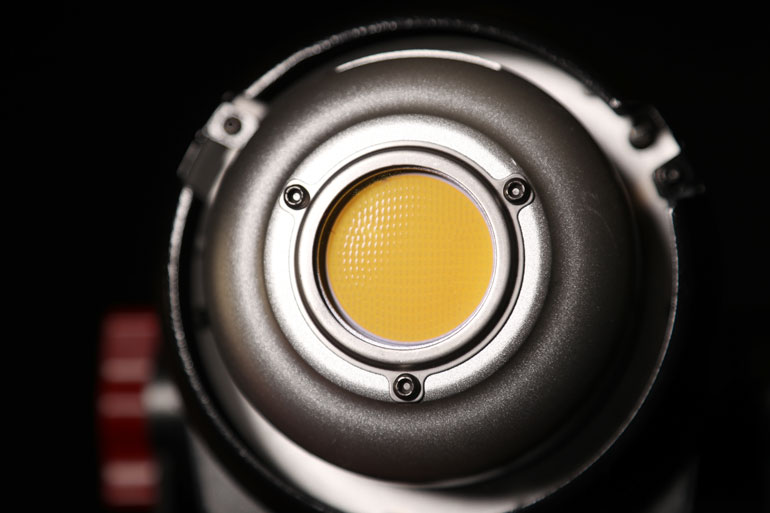
The LS 300x is the bi-color version of the 300-watt platform. It is physically the same as the LS 300d II, but instead of just being able to produce daylight (5600K), it can be adjusted to produce any white color temperature between 2,700K and 6,500K. Being able to adjust the color temperature of the light in 50K increments can be very beneficial to those who often shoot in mixed lighting conditions. The LS 300x does cost slightly more than the daylight-only version, but it loses a small amount of output at the extreme ends of the color temperature spectrum. Overall, the loss of output is worth the gain in flexibility.
LS 600d and LS 600d Pro
The LS 600d is the workhorse of the lineup. At 600 watts, it produces 98,500 lux at one meter with the included Hyper Reflector. While it may not be as bright as a 1200W HMI, it produces the same amount of light while consuming less energy (only 720 watts). The Color Rendering Index (CRI) is 96, and the Television Lighting Consistency Index (TLCI) is 96, both of which are good for an LED at this output level.
Reviewers at B&H seem to really like the LS 600d. One reviewer stated that the 600d is better than his 300d in every way and could provide adequate lighting for a room using a single unit with 6x6 diffusion. Another reviewer stated that he has successfully used the 600d as a key light through a light dome or grid cloth, and that it can overpower windows to be used as a fill light for interviews.
Many reviewers praised the integration with the Sidus Link app, stating that the app allowed them to easily access and control their lights remotely.
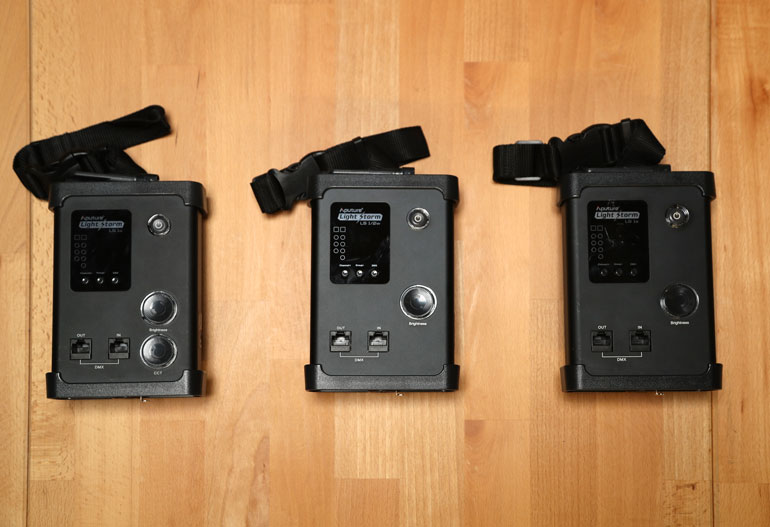
The Pro version of the LS 600d includes wireless DMX via LumenRadio CRMX, Art-net compatibility, increased weather resistance, and battery charging through the control box. The control box is larger and heavier than the standard version. Unless you need the wireless DMX or Art-net capabilities, the standard version of the LS 600d is the more affordable option while still providing the same level of light output.
LS 600c Pro II
This is the full-color version of the 600-watt fixture and can produce any color temperature between 2,300K and 10,000K. The LS 600c Pro II produces 91,500 lux at one meter at 5600K with the Hyper Reflector, which is an 82% increase in output from the original 600c Pro it replaced. The LS 600c Pro II also carries an IP54 weather rating.
As of the writing of this article, the LS 600c Pro II is available at a discounted rate at B&H, indicating that Aputure is trying to push customers toward the newer STORM series. If you need full-color control from a single fixture, this is the best option to consider while the price is low.
Build Quality and Reliability
Many reviewers praise the build quality of the Aputure Light Storm fixtures. They feel that the fixtures are built very well, with a metal housing that feels substantial without feeling too heavy. The fixtures come with a handbrake locking mechanism that secures the position of the fixture, and the Bowens mount provides a secure latch. These are the types of details that are important when you are placing a light overhead on a boom arm and need the light to remain stationary.
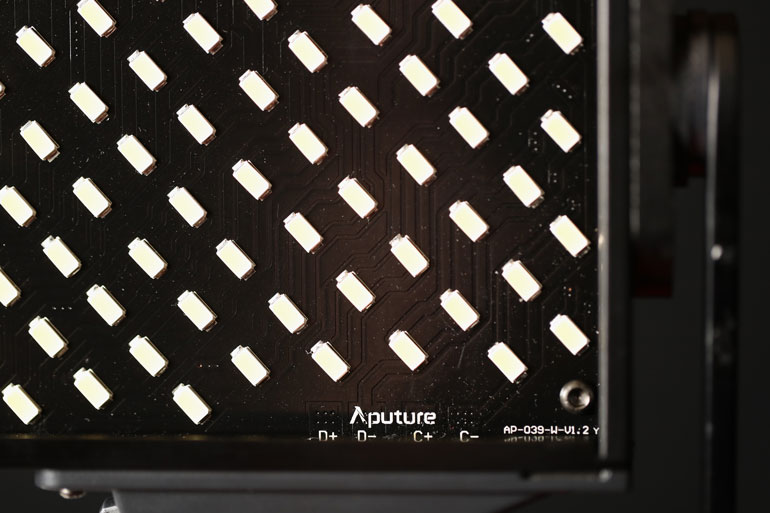
All of the control boxes on the 600-series fixtures include two V-mount battery plates, allowing you to run the fixtures on batteries at half output when you are not near a power source. The control boxes for the 300d II and 120d II are separate and are smaller and lighter. All of the fixtures are capable of accepting DMX512 signals to allow for integration with larger lighting systems. The 2.4 GHz remote that comes with each fixture functions well at distances of approximately 100 meters.
One potential drawback of the Light Storm fixtures is fan noise. Because the fixtures are actively cooled, you will be able to hear the fans. However, for most video applications, this should not be a problem. Some reviewers mentioned fan noise as the biggest compromise, but most agreed that the output-to-noise ratio was acceptable for the price.
Enter the STORM Series
In 2024 and 2025, Aputure began releasing the STORM series as a next-generation replacement for the Light Storm line. The most significant technological advancement in the STORM series is the Blair light engine, an acronym that stands for Blue, Lime, Amber, Indigo, Red. The "c" models (such as the STORM 80c and 1000c) utilize Blair-CG, which includes the addition of Cyan and Green for full-color control.
The STORM lineup ranges from the compact 80c at 80 watts all the way up to the massive XT52 at 5,200 watts. Every STORM fixture has an IP65 weather rating, which is a step up from the IP54 rating on the Light Storm series. The STORM fixtures also use an updated ProLock version of the Bowens mount for more secure attachment of accessories.
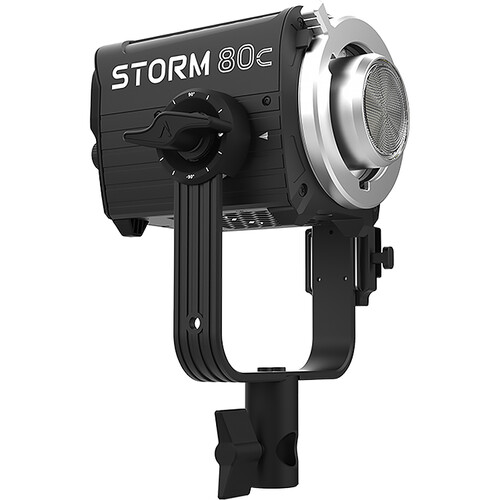
STORM 80c: The Compact Powerhouse
The STORM 80c is the most affordable entry point into the new ecosystem. A single unit is surprisingly affordable for an Aputure fixture, and the 3-light kit with compact fresnels costs roughly what you'd pay for a single LS 600d Pro. At just over 1 kilogram for the lamp head alone, it's remarkably portable. And it can be powered via AC, V-mount battery, or USB-C at 100 watts, making it genuinely useful for run-and-gun work.
B&H reviewers are loving this light. One gaffer said it punches well above its weight and operates at a brightness well beyond 80 watts. Another user noted it replaced his 300c entirely.
The 1,800K to 20,000K color temperature range is almost unheard of in a fixture this small, and reviewers praise the CRI quality and Sidus Link integration. The 3-light kit users mention it's a solid foundation for a complete lighting setup, though you'll want to add your own stands and maybe a larger softbox to round things out.
STORM 700x and Beyond
The STORM 700x is positioned as the direct replacement for the LS 600d Pro and LS 600x Pro. At 700 watts with tunable white from 2,500K to 10,000K, Aputure claims it's roughly 3x brighter than the LS 600x Pro at three meters. It's priced similarly to the light it replaces while offering substantially more output.
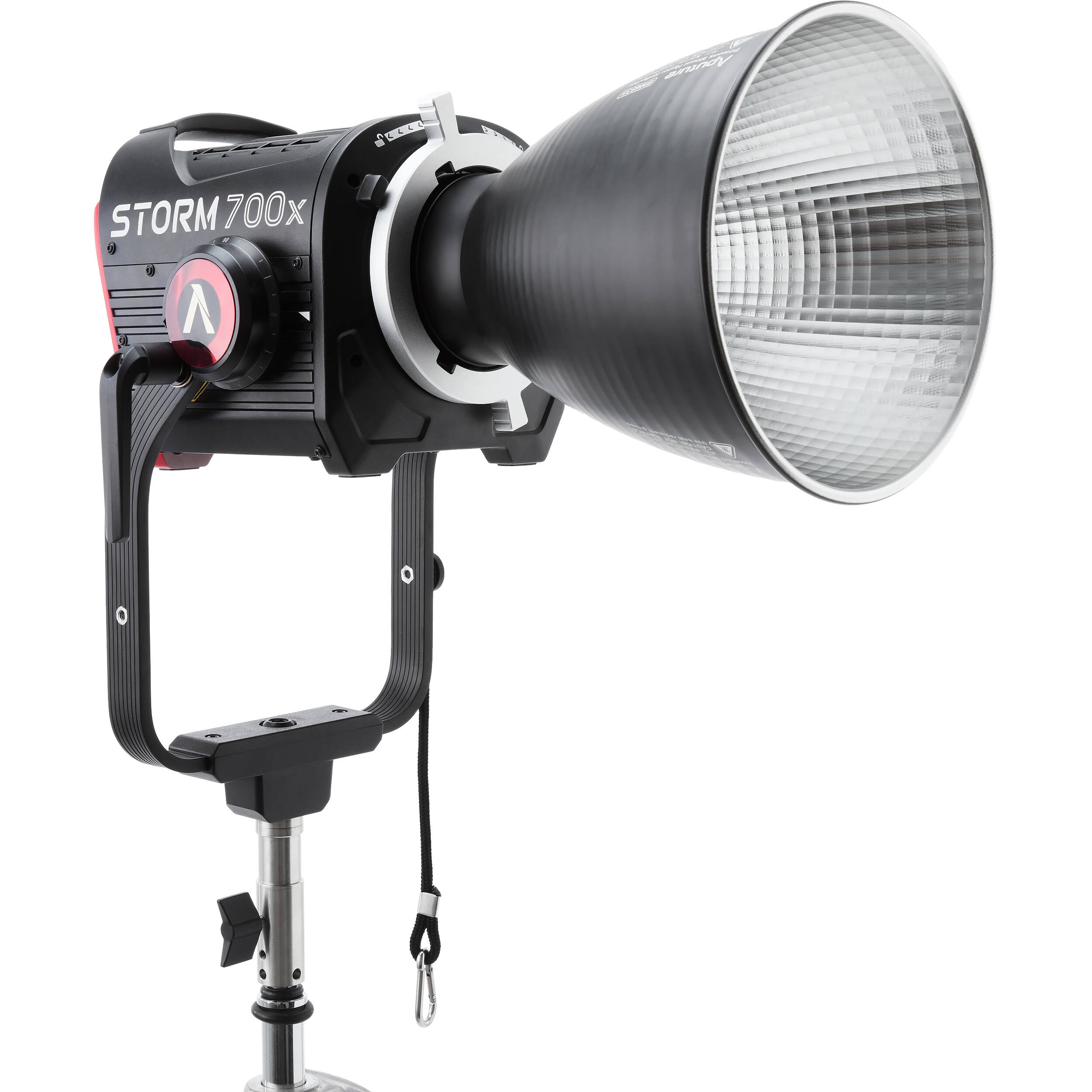
Further up the lineup, the STORM 1200x replaces the discontinued LS 1200d Pro with tunable white capability, better weather sealing, and actually costs less than the light it replaced. And then there's the STORM XT52, a 5,200-watt fixture that rivals 9,000W HMIs, clearly aimed at the feature film and commercial market where raw output is everything.
Which Light Storm Fits Your Kit
When the decision comes down to purchasing either a Light Storm or STORM series product, it really depends upon your level of production scale and your budget.
The LS 120d II is a good choice for the first-time filmmaker buying their first lighting kit, it is affordable and provides great versatility. When paired with a softbox, it makes a fantastic key light for interviews.
The LS 300d II is the sweet-spot for independent productions, it has sufficient output to serve as a key through diffusion or to provide soft fill when bounced off a wall in a room. This seems to be the go-to choice for many videographers currently working in the industry, it provides a great combination of price and output and fits seamlessly into a growing Aputure fixture ecosystem.
The LS 600d is intended for productions that require significantly greater output, the ability to overpower window light, push through heavy diffusion, or light larger spaces. The value proposition for this unit is for those engaged in narrative, commercial, or corporate work that requires greater output.
Finally, if you're just starting from scratch in 2026, the STORM 80c would likely make for a very attractive starting point. The full-color capability, compact design, and the fact that it can be powered via AC, V-mount battery or even USB-C at 100 watts, provides a lot of flexibility that no older Light Storm can provide. A 3-light kit would give you a complete, portable setup that could easily fit within a single rolling case. You can also see STORM 80c prices on Amazon if you wish to compare.
Frequently Asked Questions
What is the difference between the Aputure Light Storm and STORM series?
The Light Storm series is the original line-up, the STORM series is the new line-up using the Blair light engine, IP65 weather protection (versus IP54) and the new ProLock Bowens mount. The STORM products generally provide higher output levels, wider color-temperature ranges and improved build quality.
Light Storm products are still available but they are slowly being phased out in favor of the equivalent STORM products.
Is the Aputure LS 600d worth it over the 300d II?
Yes, if you find yourself needing to send light through large diffusion frames, overpowering ambient light, or illuminating larger spaces, then the 600d is the better product. The 600d produces roughly twice the output of the 300d II.
However, for interviewing and smaller productions, the 300d II is more than adequate and costs less. Users on B&H consistently recommend the 600d for anyone working in the commercial or narrative space requiring better control of their lighting. Check B&H for current availability and pricing.
Can Aputure Light Storm lights run on battery power?
Yes, the 600-series products have two V-mount battery plates built directly into the control box, however they only operate at roughly half output on battery power. The 300d II and 120d II can also operate on batteries, but this will require an additional adapter for the battery plate.
The newest STORM 80c goes further by accepting USB-C power at 100 watts allowing for the highest portability of any product in the lineup. V-mount batteries from various manufacturers work with the built-in plates.
What Bowens mount accessories work with Light Storm fixtures?
All Light Storm and STORM products use Bowens S-mount compatibility, therefore any accessory utilizing the Bowens mount will fit. Some examples of popular Bowens-mount modifiers include Aputure's own Light Dome series, the F10 and F10 Fresnel, Lantern softboxes, and barn doors. Third party Bowens mount accessories from manufacturers such as Nanlite or Godox will also fit perfectly.
How loud are the fans on Light Storm LED lights?
They are audible, especially at full output. This isn't usually a concern for most video production work, however in very quiet recording environments you may want to position the light farther away from your microphones or reduce the output (this will also reduce fan speed). Most reviewers comment that the fan noise is the primary trade-off but feel that the output and price provided is worth it.
Should I buy Light Storm or wait for STORM series models?
If budget is a concern, the Light Storm products are on sale right now at significantly discounted prices due to Aputure transitioning the products. The LS 600d and 300d II are both reliable and proven workhorses with years of reliability data to back them up.
However, if you are creating a new kit from scratch and you are looking for the best technology, the STORM series has better weather resistance, broader color ranges, and greater output per watt than the Light Storm series. The STORM 80c and 700x are the top picks for most indie filmmakers.